What if your biggest AWS cost problem is not traffic spikes, but decisions you made months ago and forgot about? According to Gartner, organizations waste up to 30% of their cloud spend and most don’t even realize it until the bill arrives.
In 2026, cloud bills are rarely high because teams are “using too much.” They are high because infrastructure quietly solidified around assumptions that no longer hold. Safety-driven overprovisioning and architectures built for speed instead of efficiency slowly turn elastic systems into permanent expense machines. By the time finance flags the numbers, the waste is already baked into how applications scale and move traffic. AWS does not punish growth. It amplifies design choices, good or bad, at scale.
Uncover why AWS costs spiral silently and how modern teams redesign cloud economics before the invoice becomes the warning signal.
Factors That Lead to Money Loss on AWS
Here are the key factors that silently drive AWS cost escalation and lock inefficiencies into cloud architectures over time:
- Over-Provisioned Compute Resources: EC2 instances and managed database capacity are sized for peak demand and left unchanged. Idle CPU and memory remain allocated and drive continuous monthly spend.
- Extended Use of On-Demand Pricing: Production workloads with stable usage stay on on-demand billing after patterns settle. This delays AWS pricing optimization and keeps compute costs higher than necessary.
- Non-Production Environments Running Continuously: Development, testing, and staging environments operate outside active working hours. Infrastructure remains active without delivering business value.
- Unused Infrastructure Components: Detached EBS volumes, outdated snapshots, inactive load balancers, and unassigned elastic IPs persist in the account. Each resource continues to generate charges.
- Lack of Resource Ownership Visibility: AWS resources lack consistent tags that identify teams and applications. Cost accountability remains unclear across engineering and finance teams.
- Incorrect Storage Tier Selection: Historical datasets and low-access objects stay in high-performance storage classes. Storage spending increases even as data access frequency drops.
- Excessive Network Data Transfers: Application traffic moves across availability zones and regions without design controls. Data transfer fees accumulate and remain difficult to trace.
- Missing Budget Controls and Alerts: Cost thresholds are reviewed after invoices are generated. Overspending continues before corrective action occurs.
- Irregular Cost Review Practices: AWS spending is reviewed infrequently across teams. Inefficient usage patterns persist across multiple billing cycles.
Best Strategies for AWS Cost Control in 2026
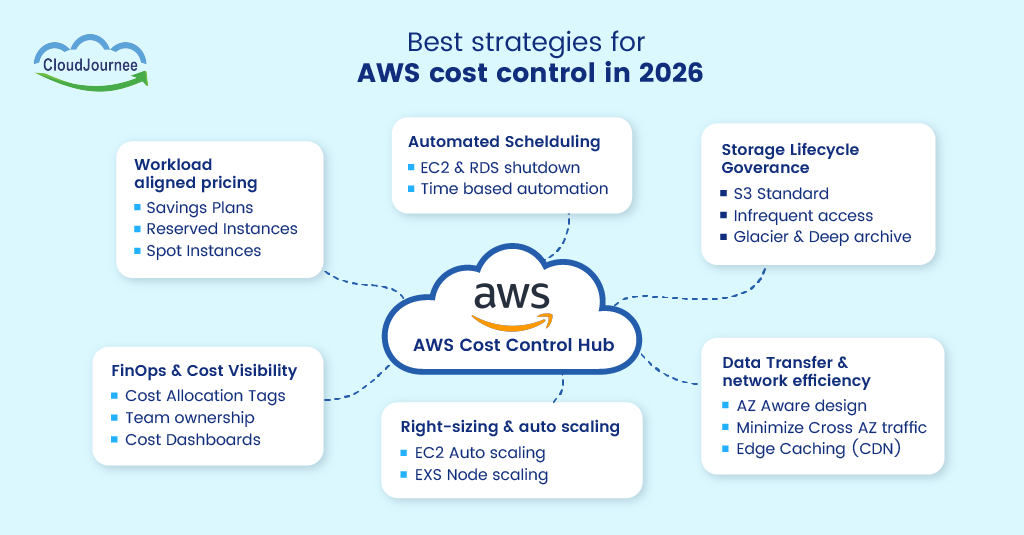
Below are the most effective strategies that help organizations control AWS spending and prevent unnecessary cloud cost leakage in 2026:
1. Right-Sizing and Auto Scaling
Cloud environments gradually drift toward excess capacity because resources are often sized once and rarely revisited. Actual workload behavior changes over time, which causes CPU and memory to remain underutilized for long periods and weakens effective AWS cost management.
Continuous right-sizing corrects this drift by aligning compute and database capacity with measured usage. It reduces AWS costs while keeping performance consistent. Auto Scaling complements this approach by adjusting capacity in response to real demand. It prevents idle infrastructure during low traffic periods and avoids rushed scaling during spikes.
Tips to implement this practice:
- Review EC2 and RDS utilization metrics over thirty and ninety-day windows
- Enable Auto Scaling policies based on sustained CPU and memory thresholds
- Use burstable instance families for uneven workloads
- Schedule quarterly rightsizing reviews as part of operational planning
2. Workload-Aligned Pricing Models
AWS pricing efficiency depends on how closely payment models reflect workload behavior, which makes pricing alignment a core pillar of AWS cost management. Predictable systems generate waste when billed at on-demand rates, which increases long-term spend and makes it harder to reduce AWS costs.
Fault-tolerant systems lose value when priced for guaranteed availability, which raises costs without benefit. Aligning pricing choices with workload stability creates a balance between flexibility and commitment, which improves budget predictability.
Tips to implement this practice:
- Classify workloads as steady, variable, or interruption-tolerant
- Apply Savings Plans to compute workloads with consistent usage patterns
- Use Spot capacity for batch jobs and background processing
- Review commitment coverage ratios every quarter
3. Storage Lifecycle and Tier Governance
Storage costs rise quietly because data continues to accumulate even when business value declines, which weakens long-term AWS cost management efforts. Frequently accessed data justifies premium storage, but historical and compliance data rarely need the same performance level.
Lifecycle governance connects data age with storage class, which helps reduce AWS costs while preserving availability. Intelligent tiering supports this model by adjusting placement as access behavior changes, which reduces manual intervention.
Tips to implement this practice:
- Define access expectations for each bucket or dataset
- Apply lifecycle rules that transition aging data automatically
- Move long-retention data into archival tiers
- Track monthly storage growth and tier distribution
4. Automated Scheduling for Non-Production Environments
Development and testing systems often remain active outside working hours, which produces cost without business output and limits the ability to reduce AWS costs. This behavior persists because shutdowns rely on manual discipline. It weakens over time and complicates AWS cost management.
Automated scheduling introduces consistent control by aligning resource availability with actual usage windows. Cost savings follow naturally because idle hours are removed without affecting delivery speed.
Tips to implement this practice:
- Tag all non-production resources clearly by environment
- Apply stop and start schedules aligned with team working hours
- Exclude shared or critical test systems from global schedules
- Review savings impact to reinforce adoption
5. FinOps Ownership and Cost Visibility
Sustainable cost control requires shared responsibility rather than centralized enforcement, which defines mature AWS cost management practices. Engineers make architectural decisions that influence spend, which means visibility must reach beyond finance teams.
FinOps, short for Financial Operations is the practice of bringing financial accountability to cloud spending through collaboration between engineering, finance, and business teams. This collaboration matters because cost data becomes actionable only when ownership is clear and feedback cycles are short. By applying FinOps practices, organizations connect cloud spend directly to the teams and services that generate it. As a result, accountability improves over time, and organizations can reduce AWS costs through more informed and timely decision-making.
Tips to implement this practice:
- Enforce mandatory tagging standards for all resources
- Review cost reports during sprint or release planning
- Set budget alerts before thresholds are crossed
- Share monthly cost summaries across engineering teams
6. Data Transfer and Network Cost Discipline
Network charges increase when data moves unnecessarily across availability zones or regions, which often goes unnoticed in AWS cost management reviews. Distributed architectures amplify this effect because traffic patterns are rarely revisited after initial design.
Cost efficiency improves when data locality is treated as a design constraint rather than an afterthought. It further helps reduce AWS costs at scale. Private connectivity further reduces exposure to transfer charges and stabilizes network behavior.
Tips to implement this practice:
- Co-locate compute and data wherever possible
- Reduce cross-region replication to essential use cases
- Use VPC Endpoints for high-volume service access
- Monitor network cost trends alongside compute spend
Advanced Techniques for Structural AWS Cost Control
Here are the advanced techniques that modern teams apply to control AWS costs effectively in 2026:
-
Architectural Cost Refactoring
Mature cloud environments accumulate cost debt through early design shortcuts that remain long after workloads stabilize. Event-driven patterns, queue-based decoupling, and asynchronous processing reduce always-on infrastructure pressure and align cost with actual execution paths. These shifts change how systems consume compute and strengthen AWS cost optimization at the architectural level.
-
Granular Cost Allocation at Service Level
Aggregate account-level reporting hides inefficient services behind healthy averages. Service level cost attribution exposes uneven spend patterns and highlights components that scale disproportionately. This visibility improves AWS cost management by linking engineering decisions directly to financial outcomes.
-
Predictive Spend Modeling and Forecasting
Historical usage trends provide reliable signals when analyzed at workload granularity. Forecast models built on consumption curves allow teams to anticipate spend drift before deployment cycles lock decisions in place. This approach helps teams reduce AWS costs before inefficiencies reach production scale.
-
Commitment Optimization Through Coverage Analysis
Savings commitments lose value when coverage remains static while workloads evolve. Continuous coverage analysis aligns committed spend with real consumption patterns across compute families. Adjustments preserve utilization efficiency and reinforce AWS cost optimization over time.
-
Workload Isolation for Cost Containment
Shared infrastructure spreads cost impact across unrelated services and complicates accountability. Isolating high-variance workloads limits blast radius during scale events and improves AWS cost management through clearer ownership and attribution.
-
Automated Anomaly Detection and Enforcement
Sudden spend changes often signal misconfigurations rather than organic growth. Automated anomaly detection surfaces deviations early and triggers predefined responses. These guardrails help reduce AWS costs before anomalies turn into recurring spend.
-
Cost-Aware Deployment Pipelines
Deployment pipelines traditionally validate performance and security while ignoring financial impact. Cost-aware pipelines evaluate resource deltas before release and flag changes that exceed defined thresholds. This feedback loop strengthens AWS cost optimization during delivery cycles.
-
Regional and Zonal Placement Optimization
Resource placement decisions influence compute pricing, data transfer costs, and availability trade-offs. Periodic placement reviews keep workloads aligned with pricing structures and access patterns, which support long-term AWS cost management.
Top Tools for AWS Cost Management and Optimization
The tools below support AWS cost optimization by linking usage behavior and operational control into a single feedback loop that helps teams reduce AWS costs without compromising reliability.
-
AWS Cost Explorer
AWS Cost Explorer provides time-based visibility into service, account, and region-level spending. Historical trends reveal where cost patterns solidify over time rather than spike temporarily. This visibility supports proactive AWS cost management by helping teams identify persistent spend drivers before they become structural.
-
AWS Budgets
AWS Budgets defines spending and usage thresholds across accounts and environments. Alerts surface cost drift during the billing cycle rather than after invoices close. Early signals give teams the opportunity to intervene before overspend becomes embedded in delivery plans.
-
AWS Compute Optimizer
AWS Compute Optimizer evaluates real workload utilization using performance metrics collected over time. Rightsizing recommendations expose compute and database capacity that exceeds actual demand. These insights directly support cost reduction by correcting allocation decisions that no longer match workload behavior.
-
AWS Trusted Advisor
AWS Trusted Advisor scans accounts for underutilized and idle resources across compute, storage, and networking. Findings expose infrastructure that continues to generate cost without contributing to application value. Regular review strengthens operational hygiene and prevents the silent accumulation of waste.
-
AWS Billing and Cost Management Console
The Billing and Cost Management Console consolidates usage, invoicing, and payment data across accounts. Centralized visibility aligns finance and engineering teams around a shared cost baseline. This alignment improves decision-making and reinforces accountability across teams.
-
AWS CloudWatch Metrics
AWS CloudWatch provides utilization metrics that explain why resources cost what they do. CPU, memory, and network patterns expose inefficiencies that billing data alone cannot reveal. These signals guide informed scaling and allocation adjustments.
-
Savings Plans and Reservation Utilization Reports
Savings and reservation reports track commitment coverage and actual usage alignment. Underutilized commitments surface quickly, which prevents capital from remaining locked into unused capacity. Continuous review keeps long-term spend aligned with real consumption.
Together, these tools form the operational backbone of disciplined AWS cost management. Visibility highlights patterns and insights that guide corrective action before inefficiencies scale across environments.
Conclusion
The question of how to reduce the AWS bill in 2026 is no longer about cutting infrastructure or compromising reliability. It focuses on gaining clear visibility into cloud spend and tuning architectures for efficiency.
Organizations that treat AWS cost management as a continuous discipline achieve stronger price performance and predictable cloud economics. Ready to take control of your AWS spending? CloudJournee helps teams reduce AWS costs by 20-40% while maintaining peak performance through deep usage analytics and continuous cost governance. Schedule your free AWS cost assessment today and discover exactly where your cloud dollars are going, and how to redirect them toward growth.