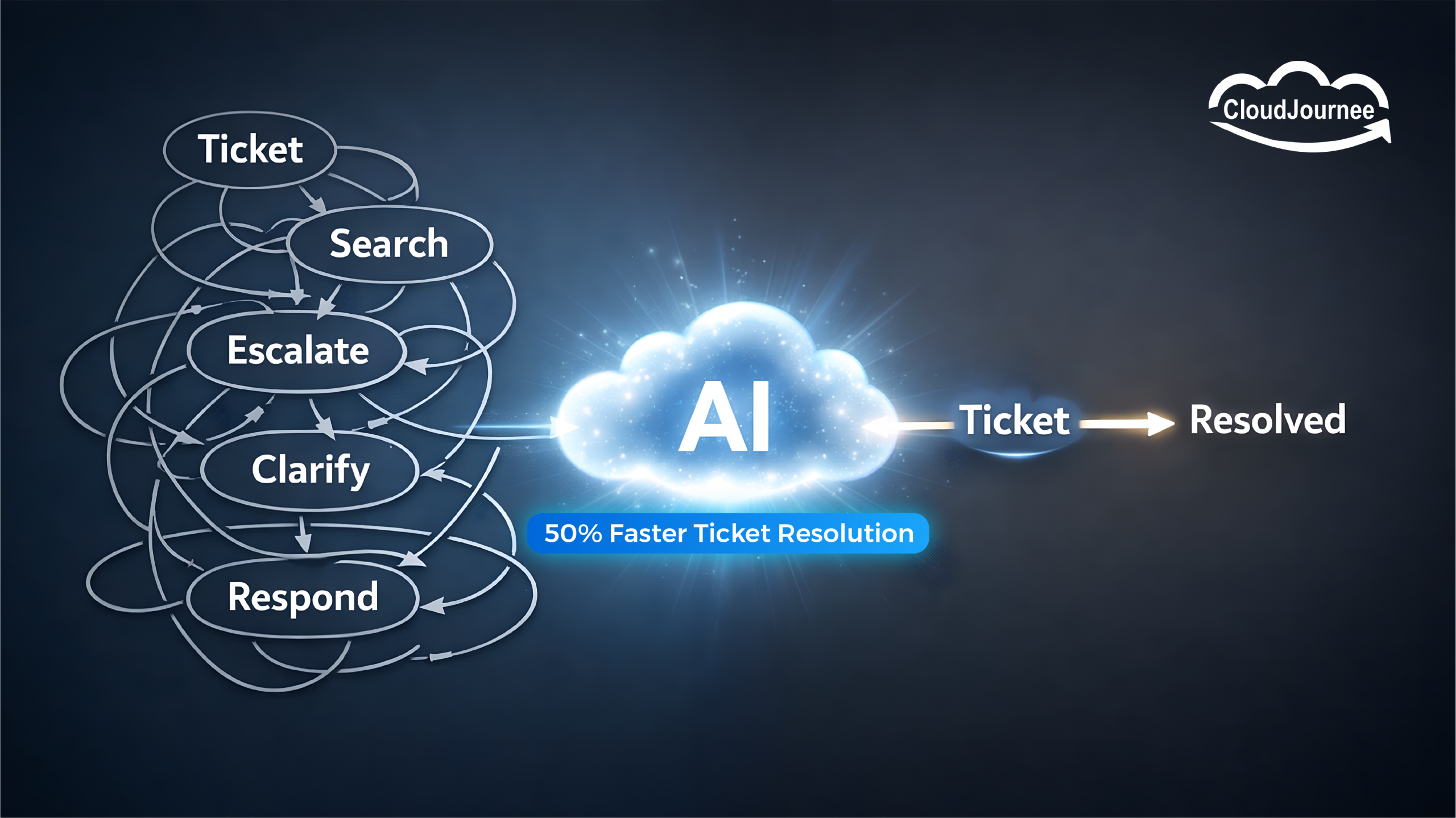
What if your customer support team could resolve issues in minutes instead of hours without increasing headcount?
For most organizations today, the challenge is not just the volume of support tickets—it is locating the right answer quickly. Traditional automation can respond instantly, yet it often lacks the context needed to resolve complex issues. Human agents understand that context, but they spend valuable time searching across systems and past cases. RAG-powered AI, or Retrieval-Augmented Generation, bridges this gap by combining generative intelligence with real-time knowledge retrieval, enabling faster and more informed resolutions.
Explore how organizations are using AI ticket resolution and AI helpdesk automation to streamline workflows through modern GenAI services and GenAI consulting strategies.
What Is RAG and Why Does It Matter for Customer Support?
Effective customer support depends on having the right information at the right time, but accessing that information typically slows down live conversations. Before responding, agents must search through documentation and historical tickets. This delays resolution and introduces inconsistency. Retrieval-Augmented Generation, or RAG, addresses this by connecting generative AI directly to enterprise knowledge bases, enabling simultaneous retrieval and response generation.
The model first retrieves relevant internal information, then generates responses grounded in that knowledge. Traditional chatbots relied on static scripts and keyword triggers, struggling with complex queries and requiring frequent manual updates. RAG, by contrast, connects AI intelligence to live organizational data, making customer support more reliable and closely aligned with business objectives.
Below is a comparison of RAG-powered AI and traditional support automation approaches. Note that RAG systems require quality data foundations and careful integration; the benefits below assume a well-executed deployment.
| Criteria | RAG Powered AI | Traditional Automation |
|---|---|---|
| Knowledge Access | Real-time enterprise retrieval | Static scripts and databases |
| Context Handling | Intent-aware and contextual | Keyword and rule-based |
| Response Quality | Grounded in verified data | Often generic or outdated |
| Adaptability | Updates with new knowledge | Requires manual changes |
| Resolution Speed | Faster decision support | Slower validation cycles |
| Scalability | Scales without added headcount | Depends on workforce growth |
| Query Handling | Handles complex cases | Limited to predefined issues |
| Operational Value | Drives efficiency and insights | Focuses on basic automation |
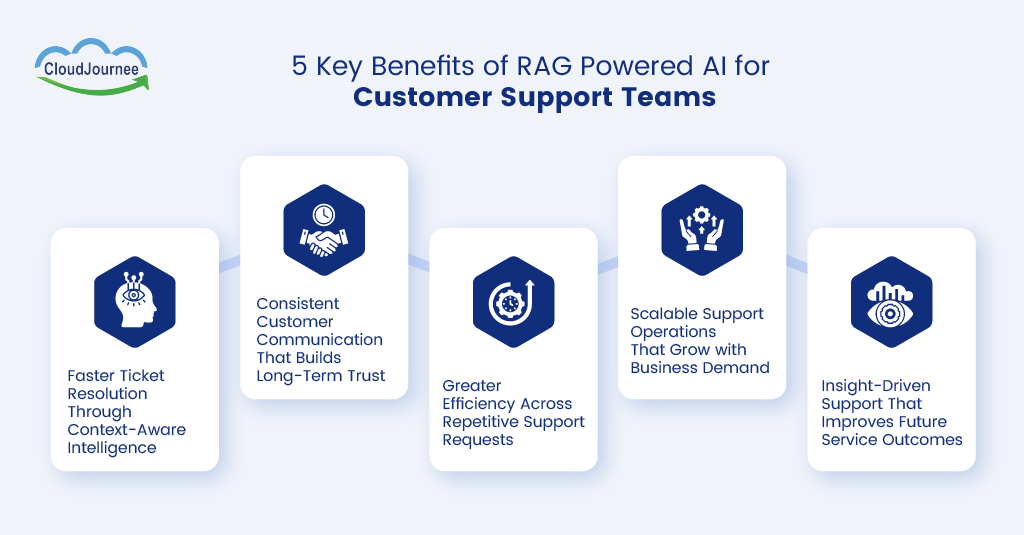
5 Key Benefits of RAG Powered AI for Customer Support Teams
Here are the top five ways RAG-powered AI is reshaping customer support performance and efficiency:
- Faster Ticket Resolution Through Context-Aware Intelligence
Customer support teams often lose valuable time searching across multiple systems before they can begin solving a problem. This fragmented access to knowledge slows response cycles and increases customer frustration. RAG-powered AI addresses this challenge by retrieving precise information from verified internal sources at the moment a ticket is opened.
The agent receives context aligned with past resolutions and product data within a single interface. This continuity between question, knowledge retrieval, and response allows teams to act immediately, which leads to shorter resolution timelines and more efficient use of expertise.
- Consistent Customer Communication That Builds Long-Term Trust
Speed alone cannot improve service outcomes if responses vary in accuracy. Many organizations struggle with inconsistency because agents rely on personal interpretation or outdated references. AI ticket resolution creates a unified knowledge foundation that guides every interaction according to approved and current information.
Customers receive the same reliable answers across channels, which reduces confusion and prevents repeat queries. This alignment between knowledge and communication strengthens trust. It also ensures that efficiency gains do not compromise service quality.
- Greater Efficiency Across Repetitive Support Requests
Consistency naturally leads to another operational advantage, which is the ability to manage recurring issues with far less manual effort. A significant percentage of support demand involves known problems that follow established resolution paths.
AI helpdesk automation sees these trends as they happen and suggests remedies based on what has worked in the past. Agents check and send responses fast, which gives them more time to work on complicated instances that need more thought. Repetitive diagnostics no longer take up most of the team’s time, thus workflows are more balanced.
- Scalable Support Operations That Grow with Business Demand
Organizations gain the proficiency to handle rising ticket volumes without expanding teams at the same pace as efficiency improves. Business growth often creates service pressure that traditional hiring models cannot sustain.
AI introduces a scalable intelligence layer that supports agents with contextual knowledge and manages predictable inquiries independently. Support functions expand in capability rather than size, which allows companies to maintain service standards while controlling operational costs.
- Insight Driven Support That Improves Future Service Outcomes
Operational scalability also generates a valuable stream of service data that can guide long-term improvements. Every interaction processed through AI systems contributes to a clearer understanding of recurring issues and customer expectations. Analyzing this data reveals patterns that inform documentation updates, product refinement, and workflow optimization. Support teams, therefore, evolve from reactive problem solvers into strategic contributors who help prevent issues before they arise.
How RAG-Driven AI Ticket Resolution Works
Step 1: Query Understanding
The system starts by using natural language processing to figure out the ticket’s intent and context. This interpretation allows the platform to understand what the customer needs rather than relying on keyword detection alone. An accurate understanding at this stage prevents misclassification and sets the foundation for precise resolution.
Step 2: Knowledge Retrieval
Once the request is identified, the system retrieves relevant information from trusted internal sources, including past tickets, product documentation, and approved support procedures. This retrieval ensures that responses are grounded in verified organizational knowledge rather than broad model training alone. Agents gain visibility into information that reflects current business operations.
Step 3: Contextual Response Generation
The model then generates a response aligned with the retrieved knowledge and the specific customer issue. The output reflects real case history and operational guidelines, which removes uncertainty and reduces the need for repeated investigation. Responses remain accurate because they are built on enterprise data rather than assumptions.
Step 4: Agent Augmentation
Support teams receive AI-suggested resolutions within their workflow, which they can review, refine, and deliver to the customer. Human validation preserves accountability while the AI accelerates analysis and preparation. Teams maintain control over communication while benefiting from faster decision support.
Core Technologies Behind RAG Powered AI
Here are the core technologies that power RAG-driven AI systems in modern customer support environments:
| Technology Component | Role in RAG Powered AI |
|---|---|
| Large Language Models | Generate human-like responses aligned with user queries |
| Knowledge Retrieval Systems | Fetch relevant enterprise data in real time |
| Vector Databases | Store and index organizational knowledge for fast semantic search |
| Natural Language Processing | Interprets intent, context, and query meaning |
| Data Connectors | Link AI systems to CRM, documentation, and support platforms |
| Security Frameworks | Govern data access, privacy, and compliance requirements |
| Feedback Loops | Refine accuracy through continuous learning from interactions |
Why RAG-Powered Systems Reduce Resolution Time by 50%
Here is how RAG-powered systems create measurable improvements in support efficiency by removing delays that occur between problem identification and solution delivery:
● Instant Access to Institutional Knowledge
Support teams depend on accumulated organizational experience, yet this knowledge often remains difficult to access during live cases. RAG organizes this knowledge into a structured, searchable format that agents can access instantly. The technology connects users to reliable insights built on years of operational data, enabling informed decisions without extensive manual research.
● Elimination of Repetitive Investigations
Many service environments repeatedly analyze the same category of issue even after solutions already exist. RAG recognizes these recurring patterns and presents validated resolutions that align with earlier successful outcomes. Teams avoid restarting diagnostic processes, which preserves time and maintains continuity across similar cases.
● Faster First Response Time
Response delays often occur during the initial assessment phase, where agents determine how to address a request. RAG reduces this delay by presenting a clear direction at the outset of the interaction. Customers receive informed replies earlier in the lifecycle of the ticket, which improves service perception and prevents backlog accumulation.
● Improved First Contact Resolution
Resolution quality improves when responses reflect complete and context-aligned information. RAG enables support teams to address issues comprehensively during the first interaction, which reduces the need for follow-ups or escalations. Customers experience fewer handoffs, and service teams maintain smoother workflows as a result.
Role of GenAI Services in Deploying RAG Solutions
Successful RAG implementation depends on more than model selection. Organizations require structured integration that connects AI capabilities to real operational environments. GenAI services provide this bridge by aligning data and workflows, so AI functions as an extension of enterprise knowledge rather than an isolated tool.
● Custom Knowledge Integration
GenAI services connect AI systems to organization-specific data ecosystems that contain product documentation, service histories, and internal policies. This connection allows responses to reflect real business context instead of generic model outputs. Support teams benefit from intelligence shaped by their own operational knowledge.
● Secure Architecture Design
Enterprise deployment requires strong governance over how data is accessed, processed, and stored. GenAI services establish architectures that respect compliance requirements and protect sensitive customer information. Security frameworks remain intact while AI capabilities operate within approved boundaries.
● Workflow Alignment
Technology adoption delivers the greatest value when it enhances existing processes rather than replacing them entirely. GenAI services integrate RAG capabilities into existing CRM and helpdesk platforms, allowing agents to continue working within familiar systems. This alignment minimizes disruption and accelerates adoption across teams.
● Performance Optimization
AI systems improve through continuous evaluation and refinement. GenAI services monitor retrieval accuracy, adjust data connections, and optimize response quality based on user feedback. This ongoing tuning ensures the system remains relevant as products, policies, and customer expectations evolve.
Why Businesses Are Investing in GenAI Consulting
Organizations recognize that deploying AI without strategic direction leads to fragmented outcomes. GenAI consulting provides the planning and governance required to translate technical capability into measurable service improvement.
● Strategy Before Technology
The first step in GenAI consulting is identifying where automation can add measurable value to support workflows. Consultants analyze ticket patterns, knowledge hierarchies, and operational constraints to determine the optimal approach for RAG deployment. This methodology prevents unfocused adoption and ensures that investments align with clearly defined objectives.
● Change Management and Adoption
AI integration affects people as much as systems. Consultants guide teams through training programs, governance models, and process adjustments so employees understand how to collaborate with AI tools. Structured adoption ensures that new capabilities strengthen performance rather than create uncertainty.
Core Use Cases of RAG Powered AI in Support Operations
RAG-powered AI and GenAI consulting services support a wide range of service scenarios where accuracy and contextual understanding are essential to maintaining reliable customer experiences.
- Automated troubleshooting for technical products that require guided diagnostics
- Intelligent knowledge base search that surfaces precise answers for support agents
- Context-aware chatbot escalation that transfers cases with complete background information
- Real-time resolution suggestions delivered during live chat interactions
- Multilingual customer support that maintains consistency across global audiences
- Compliance-aligned response generation based on regulated documentation and policies
These applications show how RAG moves beyond basic automation to deliver structured, knowledge-driven assistance across the entire support lifecycle.
Best Practices for Successful RAG Deployment
RAG deployment succeeds when technology, data, and operations function as a unified initiative rather than separate projects. Organizations that approach implementation as a strategic transformation—rather than an experimental overlay—experience faster adoption, stronger governance, and deeper integration into everyday workflows.
This approach delivers impact across support environments through:
- Integrating enterprise knowledge into AI-driven decision support.
- Ensuring secure deployment that adheres to data governance and compliance standards.
- Achieving seamless interoperability with existing CRM and helpdesk systems.
- Driving continuous improvement to maintain accuracy and business relevance.
The Bottom Line
RAG-powered AI is transforming customer support by connecting real enterprise knowledge to intelligent automation. Organizations that adopt this approach resolve issues faster, communicate with greater consistency, and scale operations without compromising accuracy or governance. This shift elevates support functions from cost centers into data-driven engines that improve both customer satisfaction and operational efficiency. Companies that embrace this model position themselves to deliver responsive, high-quality service in markets where speed and precision define competitive advantage.
Ready to operationalize RAG with confidence? Schedule a free RAG readiness assessment with CloudJournee to evaluate your support infrastructure, identify high-impact automation opportunities, and build a deployment roadmap tailored to your enterprise ecosystem.