How often do cloud teams chase performance gains only to see AWS bills rise quietly in the background?
The assumption that lower costs require weaker performance still shapes many cloud decisions, yet the real issue lies elsewhere. Sustainable cost control comes from visibility and intentional architecture rather than aggressive cutbacks. When teams approach AWS cost optimization as an ongoing discipline, they reduce waste without slowing systems down.
Learn how to reduce AWS costs without sacrificing performance and build cloud systems that scale with confidence.
Understanding Why AWS Costs Rise Without Performance Gains
AWS costs rise without performance gains because decisions made early in system design quietly become permanent operating assumptions. Initial architectures are usually built under pressure to ship quickly and stay reliable, so teams size infrastructure with generous buffers that feel safe at the time. Those buffers remain in place as real traffic patterns emerge, allowing overprovisioning to persist even when workloads no longer justify it. Static scaling reinforces this problem because capacity stays fixed regardless of demand variation, which turns elasticity into constant allocation. Over time, spend increases even though latency and user experience remain unchanged.
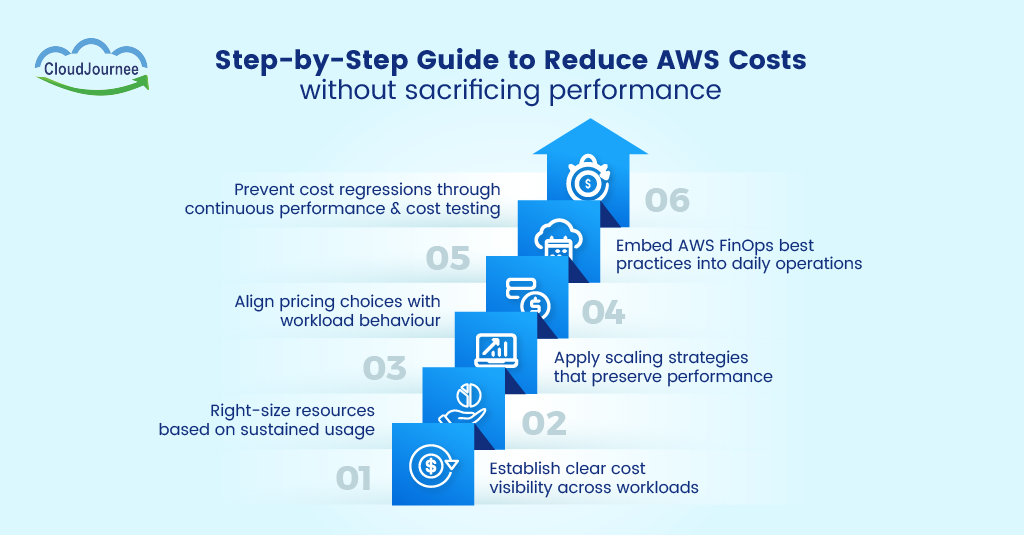
Step-by-Step Guide to Reduce AWS Costs Without Sacrificing Performance
Here is how teams can systematically lower AWS spending while keeping application reliability and throughput intact:
Step 1. Establish Clear Cost Visibility Across Workloads
Reducing cloud spend starts with understanding where money is going and why it is being spent. Many teams attempt to reduce AWS costs without first establishing visibility, which leads to reactive actions that hurt performance. Clear cost visibility connects resource usage with business workloads and engineering decisions. This foundation strengthens AWS cost management because teams can see persistent cost drivers rather than isolated billing spikes.
Best ways to implement this step:
- Enforce consistent resource tagging by application, environment, and owner
- Review service-level and workload-level cost trends monthly
- Correlate usage metrics with spend to identify structural inefficiencies
- Share cost visibility dashboards with engineering teams
Step 2. Right-Size Resources Based on Sustained Usage
Over time, workloads drift away from their original sizing assumptions. Capacity remains allocated long after demand patterns change, which weakens AWS cost efficiency. Right-sizing based on sustained usage aligns infrastructure with real workload needs while maintaining performance stability. This approach supports AWS cost optimization because it removes waste without reducing critical headroom.
Best ways to implement this step:
- Analyze CPU, memory, and I/O trends over extended periods
- Adjust capacity incrementally to avoid performance regression
- Schedule regular rightsizing reviews as part of operations
Step 3. Apply Scaling Strategies That Preserve Performance
Static capacity creates waste during low demand and risk during spikes. Scaling strategies that follow real demand patterns protect throughput while controlling spend. Proper scaling enables AWS cost savings because resources expand and contract with usage rather than remaining fixed. Performance remains consistent because scaling rules respond to actual load signals.
Best ways to implement this step:
- Separate baseline capacity from burst capacity
- Use demand-driven scaling policies aligned to application behavior
- Test scaling responses under simulated load conditions
- Monitor latency and error rates during scale events
Step 4. Align Pricing Choices With Workload Behavior
Pricing decisions influence long-term spend more than short-term optimizations. Costs rise even when usage remains flat when pricing models do not match workload stability. Aligning commitments with real consumption improves AWS cost management without locking teams into rigid structures. This balance enables predictable spending while preserving flexibility.
Best ways to implement this step:
- Classify workloads by predictability and variability
- Apply commitments only after usage patterns stabilize
- Review commitment utilization regularly
- Avoid long-term pricing decisions for experimental systems
Step 5. Embed AWS FinOps Best Practices Into Daily Operations
Cost efficiency degrades when it is treated as a periodic exercise. Embedding AWS FinOps best practices into engineering workflows keeps cost awareness active without slowing delivery. Financial accountability aligns with technical ownership, which strengthens AWS cost optimization and long-term governance. Teams reduce AWS costs consistently because efficiency becomes part of how systems are built and operated.
Best ways to implement this step:
- Include cost impact reviews during planning and releases
- Assign clear ownership for cloud spend by service
- Set budget thresholds that trigger early alerts
- Conduct regular cost retrospectives alongside performance reviews
Step 6. Prevent Cost Regressions Through Continuous Performance and Cost Testing
One critical area often missed in AWS cost optimization guides is preventing cost regression after improvements are made. Many teams successfully reduce AWS costs, only to see spending creep back up as new features are released or temporary workarounds become permanent. Cost efficiency erodes quietly while performance appears unaffected without guardrails.
Continuous cost and performance testing closes this gap. It treats cost behavior as a measurable system property, similar to latency or availability. Every infrastructure change, scaling rule update, or architectural adjustment is evaluated not only for performance impact but also for cost impact under realistic load conditions.
This approach strengthens AWS cost management because teams catch inefficient changes before they reach production scale. Performance remains protected because testing validates that cost reductions do not introduce hidden bottlenecks or reliability risks.
Best ways to implement this step:
- Include cost impact checks in CI and release pipelines
- Test infrastructure changes under representative traffic volumes
- Track cost per request, cost per transaction, or cost per user over time
- Set alerts for abnormal cost growth even when performance metrics remain stable
Advanced Strategies for Sustainable AWS Cost Control
Below are advanced strategies that help control AWS costs while maintaining consistent performance:
1. Storage Optimization
Storage becomes a long-term cost driver when data placement decisions remain static while access patterns change. Frequently accessed data warrants premium storage tiers, whereas older data does not require the same performance level. Automated tiering shifts data to cost-appropriate storage classes as usage declines, keeping availability intact while reducing ongoing spend.
Cleanup activities strengthen this control by eliminating storage objects no longer needed for operations or compliance. Compression also reduces footprint, lowering both storage charges and downstream transfer costs.
Best ways to implement this strategy:
- Enable S3 Intelligent-Tiering to adjust storage classes automatically based on access patterns
- Archive infrequently accessed data to Glacier classes with defined retention rules
- Identify and delete unused snapshots, unattached EBS volumes, and obsolete log groups
- Compress large datasets before storage to reduce size and transfer overhead
2. Architectural Improvements
Architecture determines whether resources run continuously or only when work actually exists. Systems designed around always-on components accumulate cost even during idle periods. Event-driven patterns address this inefficiency by triggering compute only when a real action occurs, which aligns execution with demand.
Data movement also influences spend because cross-region transfers and external egress introduce recurring charges. Keeping processing close to data reduces unnecessary movement and stabilizes both cost and latency.
Best ways to implement this strategy:
- Shift suitable workloads to event-driven execution using SNS, S3, DynamoDB, and Lambda triggers
- Replace scheduled polling jobs with event-based workflows
- Co-locate compute and data to limit cross-region transfers
- Review outbound data flows to ensure only required traffic leaves AWS
3. Cost Management and Commitments
Cost control improves when pricing commitments align with workload stability rather than estimates made early in deployment. Predictable compute and database workloads benefit from Savings Plans and Reserved Instances (RIs), where one-year or three-year commitments reduce unit pricing without affecting performance.
RIs provide the greatest value when applied to steady-state workloads that show minimal variance over time. Budget controls and tagging strengthen this model by linking spend to ownership and intent, which enables corrective action before inefficiencies harden.
Best ways to implement this strategy:
- Apply Reserved Instances for steady EC2 and RDS workloads with consistent baseline usage
- Use Savings Plans to cover predictable compute consumption across instance families
- Review RI utilization and coverage monthly to avoid underused commitments
- Set AWS Budgets with alert thresholds to surface cost drift early
- Enforce consistent tagging to enable accurate allocation and chargeback
Conclusion
Reducing AWS costs without sacrificing performance requires discipline rather than shortcuts. When teams focus on visibility, sustained usage patterns, and intentional architecture, cloud spend aligns naturally with business demand. Performance stays reliable because capacity decisions follow real workload behavior. Over time, AWS cost optimization becomes a structural advantage that supports predictable growth instead of reactive correction.
Ready to optimize without compromise? CloudJournee helps teams reduce AWS costs by 20-40% while maintaining peak performance. Schedule your free AWS cost assessment today and get a custom roadmap to sustainable cloud savings.