
This case study covers CloudJournee’s implementation of a production-grade AI Slack automation platform, enabling natural language execution of Jira, Confluence, onboarding, and DevOps workflows using a supervised multi-agent architecture on Amazon Bedrock. The solution eliminated context switching, reduced manual operational effort, and delivered measurable productivity gains across engineering, HR, and DevOps teams.
Client Overview:
The customer operates a complex, fast-scaling SaaS platform where Slack functions as the central nervous system for all operational communication. As headcount expanded rapidly, operational friction increased across ticket creation, onboarding, documentation access, and incident response.
Engineering teams were creating over 150 Jira tickets per day, HR teams onboarded 40+ hires per quarter, and DevOps teams managed frequent production incidents; yet all workflows relied on manual coordination across Slack, Jira, and Confluence.
With limited ML operations capacity and rising compliance risk, the organization required a fully managed, secure, AWS-native AI solution that could operate entirely inside Slack while maintaining enterprise governance standards.
Business Challenge
Slack’s success as a communication hub unintentionally created a workflow bottleneck as the organization scaled.
Key Operational Barriers
- High Manual Overhead: Engineers spent 4–7 minutes per Jira ticket due to context switching. On a scale, this consumed ~12 engineering hours per day.
- Delayed Onboarding: HR teams manually collected new hire details via Slack and re-entered them into Confluence, taking 45–60 minutes per hire.
- Poor Knowledge Accessibility: Engineers spent 2–5 minutes searching across 200+ Confluence pages, often retrieving outdated information during incidents.
- Fragmented Tooling: Engineers switched between Slack, Jira, and Confluence 15–20 times per day, breaking focus and increasing cognitive load.
- Inefficient Incident Response: DevOps teams lost critical minutes summarizing tickets, finding history, and routing incidents correctly.
Quantified Business Impact
- Onboarding delays: New hire productivity delayed by 1–2 days
- Incident response: MTTR increasing 15–20% quarter-over-quarter
- Compliance risk: Jira SLA adherence dropped from 92% to 78%
- Human error: Incorrect or incomplete tickets growing at 5% month-over-month
Why Traditional Solutions Failed
- Rule-based chatbots: Required rigid intent mapping, failed on conversational Slack inputs
- Custom LLM stacks: Required heavy ML ops investment and long timelines
- Single-agent automation: Became unmaintainable as workflows expanded
- Non-AI tools: Could not reason, summarize, or orchestrate multi-step workflows
The customer needed a natural-language-first, multi-agent AI platform—fully managed, secure, scalable, and production-ready.
Implementation Plan
CloudJournee designed a supervised multi-agent architecture using Amazon Bedrock, embedded directly into Slack and orchestrated through event-driven AWS services.
Strategic Approach
- AI adoption roadmap prioritizing high-ROI workflows
- Multi-agent system design with domain-specific responsibility separation
- Serverless architecture for zero infrastructure management
- RAG-powered knowledge retrieval from Confluence
- Enterprise-grade security and compliance by default
Core Objectives
- Eliminate context switching from Slack
- Reduce manual workload across engineering and HR
- Accelerate incident response and MTTR
- Achieve >90% task completion accuracy
- Stay within <$15K monthly AWS spend
- Deliver production deployment in 8 weeks
Solution
Application Architecture
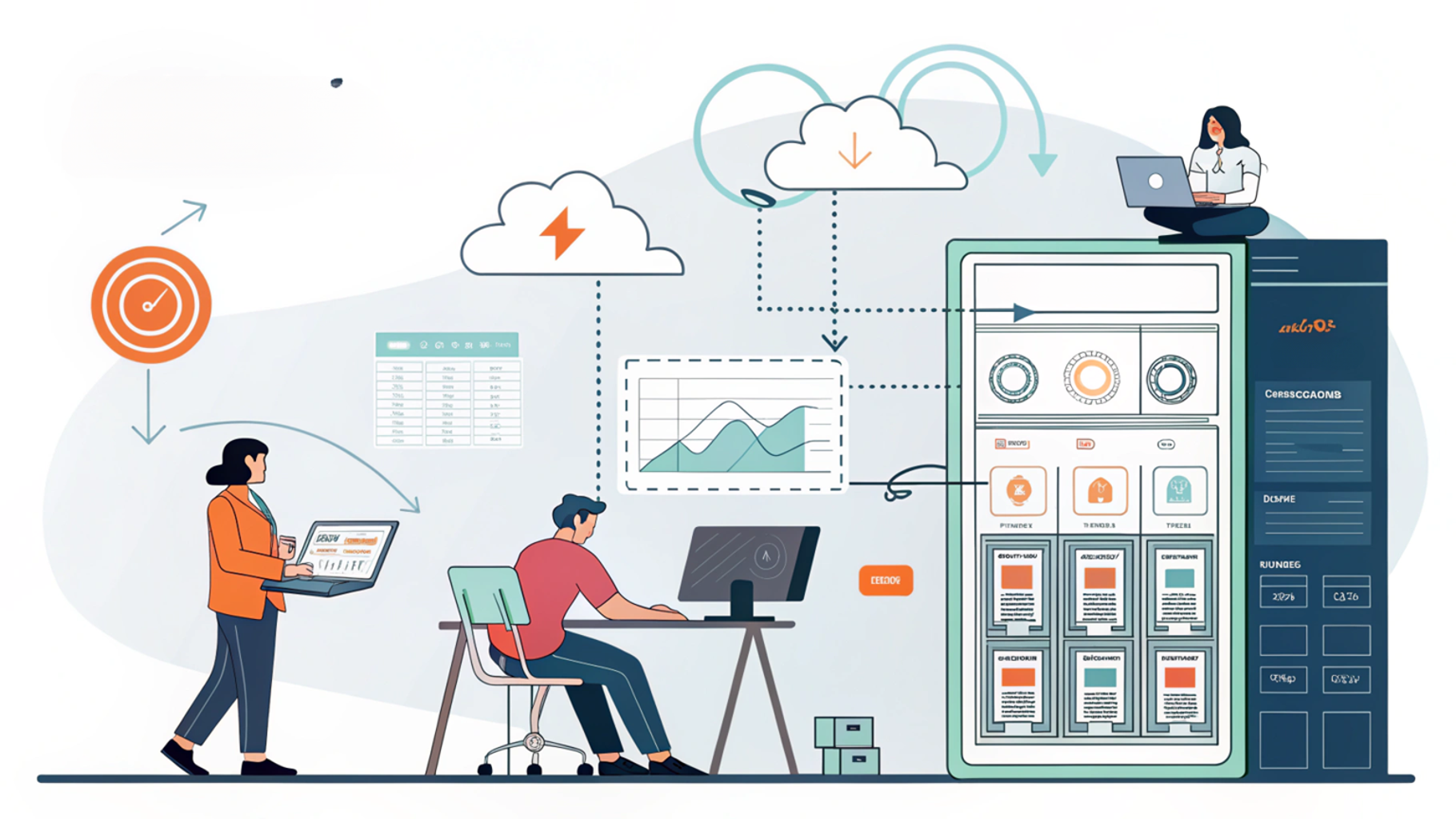
CloudJournee implemented a Bedrock-native multi-agent platform using a Supervisor orchestration pattern:
- Slack messages trigger API Gateway → Event Handler Lambda
- AWS Step Functions manage workflow execution
- Supervisor Agent (Amazon Nova Premier) interprets intent and routes tasks
- Domain-specific agents execute Jira and Confluence actions
- RAG queries executed via Bedrock Knowledge Base + OpenSearch
- Structured responses returned to Slack in real time
End-to-end execution time: <3 seconds (P50)
AWS Infrastructure Implementation
- Amazon Bedrock Agents: Native multi-agent orchestration without custom routing code
- AWS Lambda: Event handling and Action Group execution (serverless, auto-scaling)
- Step Functions: Visual orchestration with retries and error handling
- OpenSearch Service: Vector search for RAG with multi-AZ availability
- API Gateway: Secure Slack webhook ingestion with throttling and WAF support
- CloudWatch: Centralized logging, metrics, and alerting
AI Implementation
- Foundation Models
- Amazon Nova Premier: Supervisor reasoning and routing
- Claude 3.5 Sonnet: Ticket Summarization
- Titan Text Embeddings V2: 1536-dimension semantic embeddings for RAG
- Multi-Agent Design
- Supervisor Agent (routing, validation, guardrails)
- Jira Agent (3 Action Groups)
- Confluence Agent (3 Action Groups)
- RAG Strategy
- 200+ Confluence pages ingested
- 512-token chunking with 10% overlap
- Top-5 retrieval with semantic re-ranking
- <50ms vector search latency
- Prompting Strategy
- Tools-first execution
- JSON schema enforcement
- Few-shot examples per agent
- Chain-of-thought reasoning for routing
DevOps, Security & Operations
- IAM least-privilege policies
- Secrets Manager with 90-day credential rotation
- KMS encryption at rest, TLS 1.2+ in transit
- Bedrock Guardrails for PII protection
- CloudWatch dashboards for all system components
- PagerDuty + Slack alerts for incidents
- 99.94% uptime since production launch
Benefits and Key Values Realized
| Category | Before | After | Improvement |
|---|---|---|---|
| Jira Ticket Creation | 4–7 minutes | <30 seconds | 85% faster |
| Onboarding Docs | 45–60 min/hire | 45–60 min/hire | 90% reduction |
| Confluence Search | 2–5 minutes | 5–10 seconds | 88% faster |
| Context Switching | 15–20/day | 7–8/day | 50% reduction |
| Ticket Summaries | 3–5 minutes | <15 seconds | 95% faster |
| SLA Compliance | 78% | 94% | +16 points |
Quantified Business Value
- Engineering productivity: ~10 hours saved per day
- HR efficiency: 37 hours saved per quarter
- DevOps MTTR: Reduced by 22%
- Error rate: Dropped from 12% to 3%
- ROI: 280% in first year
($625K savings vs $224K total cost)
Customer Quote
“The AI-powered Slack automation has fundamentally transformed how our team’s work. What once required constant context switching now happens seamlessly within Slack. CloudJournee delivered a production-ready AI platform in just eight weeks, and the productivity gains have been remarkable. This is exactly the kind of AI automation that delivers real, measurable business value.”
— VP of Engineering
Conclusion
This transformation demonstrates CloudJournee’s ability to deliver production-grade AWS AI solutions that move beyond experimentation into real operational impact. By combining Amazon Bedrock multi-agent orchestration, serverless architecture, RAG-powered knowledge access, and enterprise security, the platform eliminated friction across engineering, HR, and DevOps workflows.
The result is a scalable, cost-efficient AI automation blueprint that delivers measurable productivity gains, high user adoption, and sustained operational excellence—while remaining fully AWS-native and compliance-ready.