
Most teams start their generative AI journey in the same place: a few well-crafted prompts, a capable model, and outputs that seem almost too good to be true. Then production arrives, and the picture changes fast.
Prompts start living in five different places. Outputs that worked in staging break in production. Costs rise without explanation. Teams spend hours debugging variance they cannot attribute to anything specific. A model update shifts behaviour in ways nobody anticipated and nobody can roll back. This is not a failure of the model. It is a failure of operations — and it is the most common pattern in enterprise generative AI deployments today.
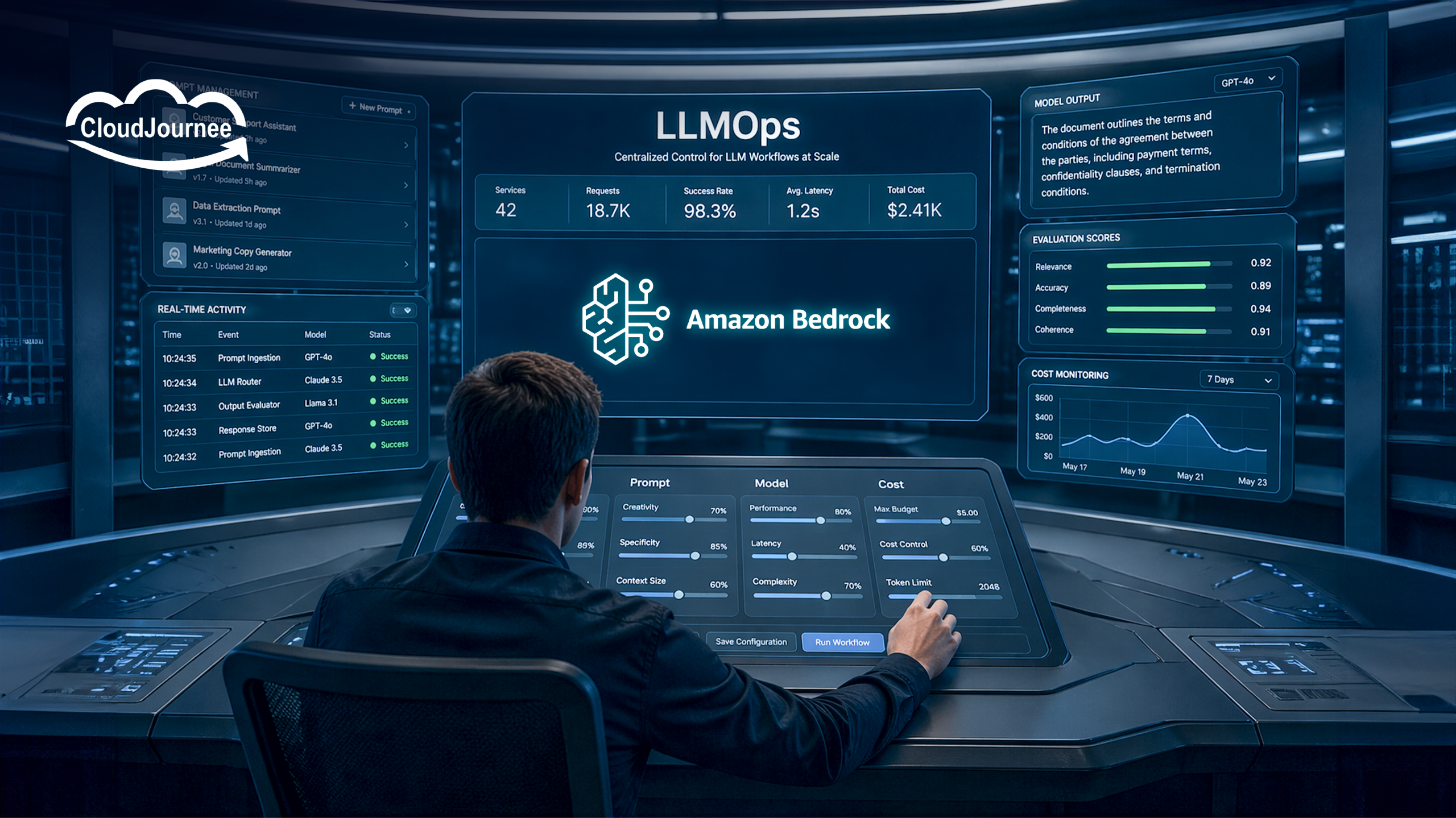
The discipline that addresses this is LLMOps: the practice of governing, evaluating, and operating large language models in production. When implemented well on Amazon Bedrock, it gives engineering and product teams a structured foundation to scale generative AI without losing consistency, predictability, or cost control. This blog breaks down what that actually looks like — not in theory, but in the specific decisions and systems that determine whether a generative AI deployment holds up under real usage.
Why Most LLM Projects Fail Quietly
The most persistent misconception in generative AI is that success depends primarily on model selection. In practice, most failures happen after the model is chosen and the initial build looks promising. Prompts are hardcoded across multiple applications with no version history, which means no one can explain why outputs changed between releases. Teams duplicate prompt logic instead of reusing it, creating divergent behaviour across environments that compounds with every iteration. Costs increase without clear attribution because no one is tracking spend at the request level. And when the business wants to switch to a newer or more cost-efficient model, the tightly coupled architecture makes it a multi-sprint engineering effort rather than a configuration change.
These are not model problems. They are operational problems — and they share a common root: the absence of structure across the lifecycle of prompts, evaluations, and usage. LLMOps is not a product or a single tool. It is the discipline that introduces that structure before the absence of it becomes expensive to fix.
Amazon Bedrock as the Foundation for LLMOps
Amazon Bedrock plays a specific and important role in an LLMOps architecture. It provides a unified API to access multiple foundation models — Anthropic Claude, Amazon Titan, Meta Llama, Mistral, and others — without requiring teams to manage model hosting, infrastructure provisioning, or deployment pipelines. This is not a trivial advantage. It means engineering effort can stay focused on application logic, prompt governance, and evaluation rather than model operations infrastructure.
The more consequential capability is model flexibility. Because Bedrock abstracts the underlying model behind a consistent interface, teams are not locked into a single provider or architecture. This matters enormously for LLMOps: it means model routing decisions — using a faster, cheaper model for simple classification tasks and a more capable one for complex reasoning — can be made at the system level rather than requiring application rewrites. It also means evaluation can be run comparatively, testing the same prompt against multiple models using identical criteria to make selection decisions based on evidence rather than assumption.
Built-in security controls, AWS IAM integration, and VPC support mean governance and compliance requirements that are non-negotiable in enterprise environments can be addressed at the platform level rather than bolted on after deployment.
Managing Prompts at Scale: From Text to Managed Asset
At small scale, prompt management feels unnecessary. A handful of prompts, a single application, and a developer who knows where everything lives. At production scale — multiple use cases, multiple teams, multiple environments — the absence of prompt management is one of the fastest ways to introduce inconsistency and operational debt.
The core principle is straightforward: prompts are product, not configuration. They directly shape user experience, they have measurable quality characteristics, and they need to be owned, versioned, and tested with the same rigour as any other product component. In practice, this means maintaining a centralised prompt repository that decouples prompt logic from application code entirely. Prompts stored outside the codebase can be updated, tested, and rolled back without a service deployment. Teams can maintain environment-specific variants — development, staging, production — without duplicating logic. Version history captures not just what changed, but why, which is the information that matters when debugging a regression.
A structured prompt lifecycle runs from design through testing to versioned deployment and continuous monitoring. The testing phase deserves particular attention: prompts should be validated against production-representative data, including edge cases and adversarial inputs, before they reach any live environment. What gets tested in isolation almost always behaves differently at scale, and catching that difference before deployment is significantly cheaper than investigating it after.
Model Evaluation: Replacing Intuition With Evidence
Choosing a model without structured evaluation is a gamble that compounds over time. The model that performs best on a public benchmark may perform poorly on your specific use case. The model that produces the most impressive outputs in a demo may have unacceptable latency under production load, or a cost structure that becomes unsustainable at scale. Without evaluation infrastructure, these trade-offs remain invisible until they become problems.
Effective model evaluation on Bedrock operates across three dimensions simultaneously. Accuracy — whether outputs meet the quality threshold defined for the use case — is the most obvious, but it cannot be assessed in isolation. Latency determines whether the system delivers an acceptable user experience under load. Cost per request, calculated on actual token usage across input and output, determines whether the system is financially sustainable at the volumes the business expects. Running the same prompt set across multiple models using identical test datasets, then scoring outputs against pre-defined criteria, produces a comparative view that makes model selection a defensible, repeatable decision rather than an opinion.
Important:
Never rely on generic benchmarks to select a model for a production use case.Benchmark datasets are designed to test broad capability, not the specific task,vocabulary, and output format your system requires. Always evaluate against your own data and your own success criteria.
Controlling LLM Costs: Why It Gets Complicated and How to Stay Ahead of It
LLM costs behave differently from most infrastructure costs. They are not driven by time or compute capacity in the traditional sense — they scale with usage at the token level, which means they are sensitive to prompt design, output verbosity, request volume, and model selection in ways that are not immediately intuitive. A prompt with fifty tokens of unnecessary context, multiplied across millions of daily requests, represents a material cost that has nothing to do with the model’s capability.
Cost optimisation in a production LLMOps system works across several dimensions. Prompt optimisation — eliminating redundant context while preserving the information the model needs — often produces the most immediate impact. Response controls, setting output token limits calibrated to the actual information required, prevent models from generating verbose outputs that inflate cost without adding value. Response caching stores the outputs of high-frequency, low-variability requests, eliminating redundant inference calls entirely for common queries. And model routing — directing simple classification or extraction tasks to smaller, cheaper models while reserving advanced models for complex reasoning — can reduce per-request cost substantially without degrading output quality for the majority of traffic.
The prerequisite for all of these is visibility. Cost must be tracked at the request level, attributed to specific prompts and workflows, and made visible to the teams making engineering decisions. Organisations that treat cost as a post-deployment concern consistently overspend. Organisations that build cost awareness into the architecture from the first sprint consistently find optimisation opportunities before they become budget problems.
What an LLMOps Stack Actually Looks Like on AWS
An LLMOps stack is not a single product. It is a set of integrated capabilities that together govern the full lifecycle of a generative AI system. On AWS, the components that matter most in production are a centralised prompt management system with version control and environment support; automated evaluation pipelines that run on a schedule and against defined test datasets; observability infrastructure that logs prompts, responses, latency, and cost at the request level; cost attribution and alerting mechanisms tied to specific workflows; and governance controls that enforce access policies and compliance requirements at the platform layer.
Amazon Bedrock handles model access and the underlying infrastructure. The observability and evaluation layer — typically built using AWS CloudWatch, custom evaluation logic, and model comparison tooling native to Bedrock — wraps that foundation with the operational intelligence needed to manage it reliably. The prompt management system sits above both, serving as the interface through which engineering and product teams interact with the models without touching infrastructure directly.
Ten LLMOps Practices That Actually Hold Up in Production
Most best practice lists read well on paper. They break the moment usage scales, teams expand, or costs get audited. The following ten practices are not theoretical — they reflect the specific disciplines that consistently separate stable LLM systems from ones that accumulate operational debt quietly.
| Practice | What it means in production |
|---|---|
| Treat prompts like product | Assign ownership, track changes with intent, document why a prompt exists — not just what it does. If no one owns a prompt, no one is accountable when it fails. |
| Design for failure | Test with edge cases and ambiguous inputs, not just ideal scenarios. Build fallback logic for output degradation. |
| Separate prompt from business logic | Keep prompts configurable outside the application layer. Updates should not require service redeployments. |
| Standardise output expectations | Define expected output formats explicitly. Enforce structure via schemas or templates. |
| Monitor for drift, not just performance | Aggregate metrics hide subtle shifts. Set alerts for deviations before users notice them. |
| Build cost awareness into every layer | Make cost visible at the request level. Set spend thresholds per workflow. |
| Avoid over-engineering early | Start simple but design for extensibility. Avoid locking into one model. |
| Align teams on evaluation standard | Define shared evaluation criteria and datasets for consistency. |
| Log everything that matters | Capture prompts, responses, latency, and cost for traceability. |
| Build for model agnosticism | Keep prompt structures portable and design switching capability early. |
Production-Readiness Checklist
Before declaring any LLM-powered system ready for production, eight questions deserve an honest answer. If most of them are “no” or “not yet,” LLMOps infrastructure is missing — and the gaps will surface as operational problems rather than technical ones.
| Area | The question to answer honestly |
|---|---|
| Prompt repository | Is there a single, centralised system where all prompts are stored and managed? |
| Version control | Are prompts version-controlled, with documented reasons for every change? |
| Real-data evaluation | Can you evaluate model performance using production-representative data? |
| Cost per request | Do you have visibility into what each inference request actually costs? |
| Model portability | Can you switch foundation models without rewriting application logic? |
| Continuous monitoring | Are outputs, latency, and drift monitored in production on an ongoing basis? |
| Output standardisation | Are expected output formats defined and validated before downstream use? |
| Failure handling | Does your system degrade gracefully when outputs fall below acceptable thresholds? |
How CloudJournee Implements This in Practice
LLMOps frameworks are easy to describe and surprisingly difficult to implement well. The gap between the documented best practice and the working production system is where most engagements lose time. At CloudJournee, as an AWS Advanced Tier Partner and holder of the AWS Generative AI Competency, we have built LLMOps infrastructure on Amazon Bedrock across multiple client engagements — and the operational patterns that matter most in each of them are consistent.
In one recent engagement, the starting point was a generative AI system where prompts were scattered across three codebases, model selection had been made on demonstration quality rather than production benchmarking, and there was no cost visibility below the monthly AWS bill. The immediate priority was prompt consolidation: a single managed repository with versioned prompts, environment-specific variants, and documented ownership. This alone eliminated the majority of the output inconsistencies the team was experiencing across staging and production — not because the prompts changed materially, but because the divergence between environments was finally visible and controllable.
The second phase was building evaluation pipelines. Using Amazon Bedrock’s model access, we ran the client’s primary use case prompts across three candidate models using identical test datasets, scoring outputs for accuracy, measuring latency under simulated production load, and calculating cost per request at the expected request volumes. The model the team had assumed was the right choice turned out to be neither the most accurate nor the most cost-efficient for their specific workload. The evaluation data made the decision straightforward and defensible to stakeholders.
Cost monitoring was implemented at the request level from the start of production deployment — each prompt tagged with workflow attribution, alerts configured for spend thresholds, and a model routing layer directing simpler classification tasks to a lighter model. The combined effect was a measurable reduction in per-request inference cost and significantly faster iteration cycles, because teams could update and test prompts without engineering involvement in deployments.
The outcome that mattered most:
was not a single metric. It was that the team gained operational confidence — the ability to change things deliberately, measure the impact, and roll back when needed. That is what LLMOps actually delivers: not just efficiency, but control.
Operations Is the Competitive Advantage
Generative AI is moving fast enough that model capability is no longer the primary differentiator. Access to capable models is broadly democratised. What separates organisations that extract sustained value from those that cycle through pilots is the ability to operate AI systems reliably — to manage prompts with discipline, evaluate models with evidence, and control costs with visibility.
Amazon Bedrock provides the infrastructure foundation. LLMOps turns that foundation into a production system that can be governed, measured, and improved over time. The organisations investing in LLMOps practices now are not just building AI applications. They are building the operational muscle that will determine how quickly they can adopt the next generation of models and capabilities as the landscape continues to evolve.
Speed without structure produces demos. Structure with speed produces systems that last.
CloudJournee holds the AWS Generative AI Competency and works with enterprises to design and implement LLMOps frameworks on Amazon Bedrock — covering prompt governance, model evaluation pipelines, cost controls, and production observability. If you are scaling generative AI and want an operational architecture that holds up under real usage,
reach out at Cloudjournee