
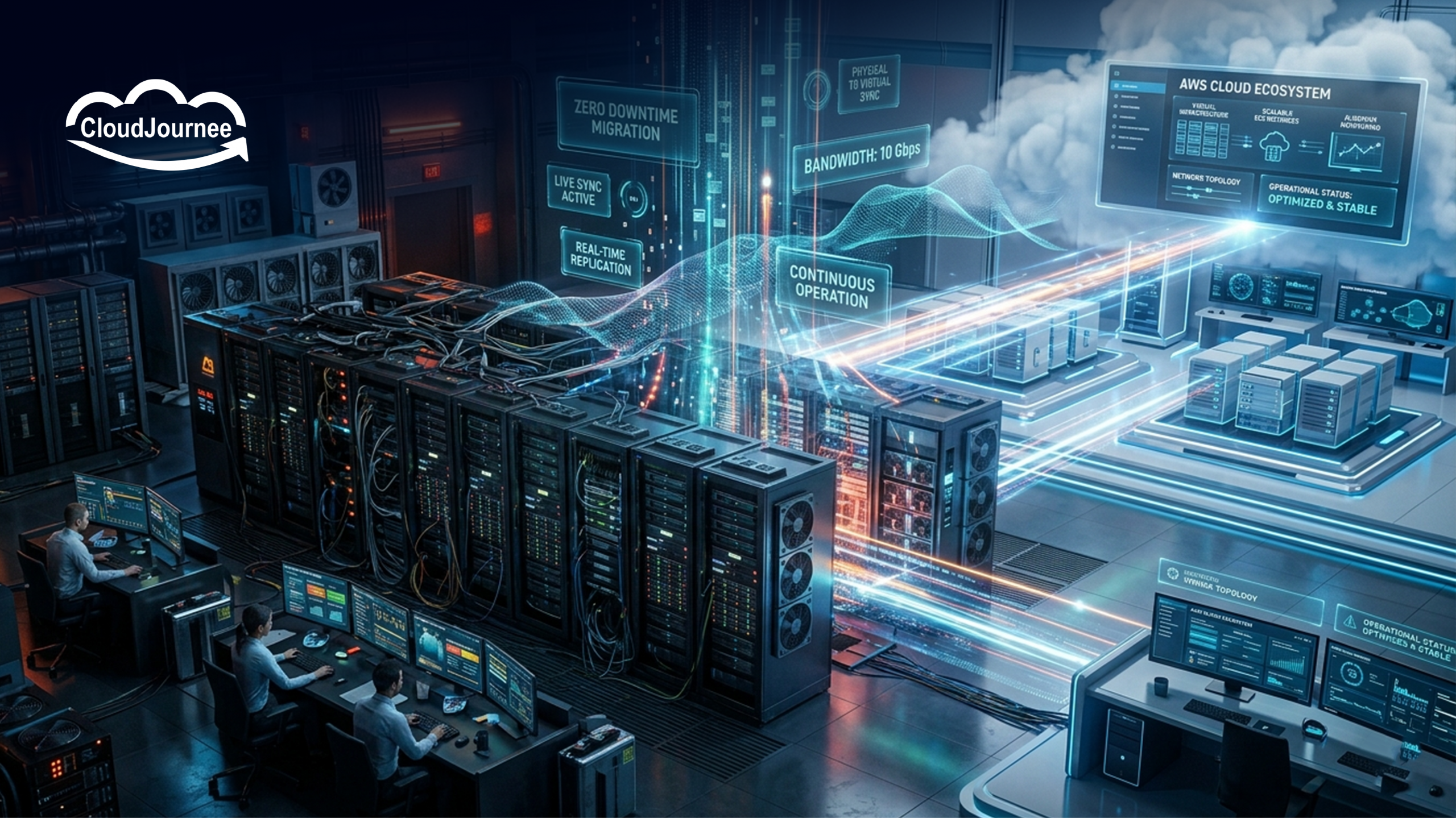
Zero downtime across 18 bare-metal servers doesn’t happen by accident.
It happens because someone spent weeks figuring out the exact order in which those servers needed to move — and what would break if they got it wrong.
That was the core challenge on a recent migration we delivered — a US-based AI startup running their entire production infrastructure on on-premises bare-metal Linux. Eighteen servers. Real workloads. A business that simply could not afford to go dark, even for an hour.
This blog walks through how the migration was executed end to end, the lessons that mattered, and what mid-market enterprises should think through before starting their own bare-metal-to-AWS journey.
Why so many enterprises are reconsidering their infrastructure
Most companies do not migrate to the cloud because they love infrastructure modernisation. They migrate because something operationally breaks first.
Deployment cycles become painfully slow. Scaling takes weeks instead of minutes. Hardware refreshes get expensive. AI initiatives stall because legacy systems cannot support modern workloads. Engineering teams spend more time maintaining infrastructure than building products.
Then the bigger realisation lands. The problem is not just infrastructure — it is business velocity. Many mid-market enterprises sit in an uncomfortable middle ground: too large for basic hosting, too small to justify multi-year enterprise SI engagements, and too operationally dependent on legacy systems to tolerate downtime during change.
That creates a dangerous bottleneck. Decision makers know modernisation is necessary, but migration risk, downtime fear, and budget uncertainty delay execution for months — sometimes years. This is exactly where a structured AWS migration strategy stops being optional.
When bare-metal stops working
Bare-metal environments work well initially — until they do not. As businesses grow, infrastructure limitations start affecting release velocity, disaster recovery, scalability, compliance readiness, AI adoption, observability, and global expansion all at once.
Eventually, even small operational failures become high-risk events. A single hardware dependency can impact multiple production systems. Scaling requires procurement cycles instead of automation. Disaster recovery plans remain theoretical because failover testing becomes operationally too risky to attempt.
At that point, infrastructure stops being a technical conversation. It becomes an executive problem.
The migration challenge most enterprises underestimate
Most organisations assume cloud migration is mainly about moving servers. In reality, servers are often the easiest part.
The real complexity comes from legacy dependencies nobody documented, interconnected applications that pass data in unexpected ways, network architecture decisions made years ago, downtime sensitivity that varies workload by workload, security and compliance policies that need to translate to a new environment, internal coordination delays across teams, and change management resistance that has nothing to do with technology.
This becomes harder still in enterprises running years of undocumented operational logic across multiple environments. The migration itself is rarely the biggest challenge. Operational continuity is.
How CloudJournee approached this migration
The starting point was not “move 18 servers to AWS.” The real objective was “migrate production workloads without operational disruption.” That distinction shapes every architecture and sequencing decision that follows.
Instead of focusing only on infrastructure replication, we evaluated critical production dependencies, peak traffic behaviour, rollback scenarios, application communication flows, downtime tolerance, security exposure, and recovery objectives — before designing the target AWS architecture.
This reduced migration risk significantly before execution even began.
The five-phase migration approach
Phase one — infrastructure and dependency discovery. Before touching the migration plan, we mapped application dependencies, database communication paths, internal service relationships, storage requirements, security controls, traffic patterns, and latency-sensitive workloads. Critically, this discovery was not done from client documentation alone. We did our own dependency mapping from actual network traffic analysis — because what’s documented and what’s running are rarely the same thing. This stage almost always reveals hidden operational risks enterprises don’t see in their own environments.
Phase two — AWS architecture planning. The target environment was designed for scalability, high availability, operational visibility, disaster recovery, and future AI readiness — not just hosting parity. We used multi-AZ deployment, elastic compute scaling, secure VPC segmentation, automated monitoring, centralised logging, and clear backup and recovery policies from day one. Migration improved operational resilience rather than simply changing the hosting address.
Phase three — parallel environment deployment. Instead of shutting systems down during migration, we deployed parallel AWS environments. This enabled real-time validation, controlled testing, traffic simulation, incremental synchronisation, and a clean rollback path if anything went sideways. Parallel environments reduced migration risk substantially — and just as importantly, reduced organisational anxiety around production cutover.
Phase four — incremental traffic migration. Rather than moving all traffic in a single cutover, workloads shifted gradually. The cutover sequence — which server moves first, which dependencies have to be live in AWS before the next one can follow, which workload would take down three others if moved out of order — was built before the first server moved. This enabled continuous monitoring, performance validation, rapid issue isolation, and controlled rollback. Incremental migration is the single biggest reason enterprises can achieve near-zero or zero downtime transitions.
Phase five — post-migration optimisation. Migration is not the finish line. After stabilisation, optimisation focused on cost efficiency, auto-scaling policies, monitoring refinement, security hardening, infrastructure automation, and AI workload readiness. Most organisations stop at “we’re live on AWS” and miss long-term cloud efficiency gains worth far more than the migration project itself.
Why zero downtime needed more than lift-and-shift
Many cloud migrations fail because teams treat AWS as a direct replacement for existing hardware. That approach creates performance bottlenecks, cost inefficiencies, security gaps, and fragile architectures that hold up for six months and then quietly start failing.
We deliberately avoided a pure lift-and-shift mindset. Instead, the migration was built around controlled workload segmentation, parallel environment validation, incremental traffic shifting, infrastructure automation, dependency isolation, and rollback preparedness at every step.
The objective was a controlled transition — not infrastructure duplication.
Where mid-market enterprises usually struggle
Large enterprises typically have dedicated transformation budgets, large consulting partners, and internal cloud engineering teams. Smaller startups move quickly because infrastructure complexity is still limited.
Mid-market companies often struggle the most. They face limited internal cloud expertise, tighter budget scrutiny, faster delivery expectations, legacy operational dependencies, smaller decision windows, and pressure to modernise quickly without disrupting the business.
That creates a gap many traditional system integrators don’t fill well. Large SIs often move too slowly. Smaller vendors may lack the enterprise operational maturity. The middle layer — where migration strategy matters as much as technical execution — is where mid-market enterprises need the most help.
Why AWS migration is increasingly tied to AI readiness
Many enterprises initially approach AWS migration as an infrastructure modernisation project. Then AI enters the conversation.
Modern AI initiatives require scalable compute environments, centralised data access, flexible storage architecture, API-ready systems, observability layers, and security governance — all things legacy bare-metal environments quietly fail to provide. Cloud migration increasingly becomes the foundation for Generative AI adoption, data platform modernisation, enterprise automation, AI-driven analytics, multi-agent systems, and workflow orchestration.
Infrastructure modernisation, in many cases, is the first real AI strategy decision an enterprise makes — whether or not they realise it at the time.
The AWS migration tools that matter
AWS provides a deep set of migration tools. For most mid-market migrations, the ones that consistently earn their place in the stack are:
AWS Application Migration Service for automated lift-and-shift of physical or cloud-based servers with minimal downtime. AWS Database Migration Service for migrating databases securely while keeping source systems operational throughout the migration. AWS Migration Hub for centralised visibility across multiple migration projects from a single dashboard. AWS DataSync for accelerated, secure data transfer between on-premises storage and AWS services. AWS Elastic Disaster Recovery for fast and cost-effective disaster recovery replication of critical workloads.
Beyond these, AWS Schema Conversion Tool, AWS Snow Family for large offline data transfers, AWS Control Tower for governance across multi-account environments, and AWS Systems Manager for ongoing hybrid infrastructure management all become relevant depending on the engagement profile.
The toolset is rarely the constraint. The strategy is.
Common AWS migration mistakes to avoid
The most common reasons migrations create operational pain are predictable.
Treating migration as a pure infrastructure exercise misses the point — successful migrations need operational alignment alongside technical execution. Ignoring dependency mapping is the fastest way to create unexpected cutover failures. Skipping rollback planning means there’s no safety net when something does go wrong. Underestimating internal communication leaves stakeholders blindsided when their systems behave differently. And optimising for speed instead of stability is how aggressive migration timelines turn into multi-month recovery projects.
The fix for all of these is the same — slow down at the start so the execution can move quickly when it counts.
A practical migration readiness checklist
Before starting a migration, mid-market enterprises should be honest about a few dimensions.
On infrastructure readiness — are all production dependencies documented and validated? Are backup systems tested, not just in place? Is monitoring already implemented or will it need to be built alongside the migration?
On operational readiness — what is the realistic downtime threshold the business can tolerate, are rollback plans documented before execution starts, and are stakeholders aligned on what success looks like?
On security readiness — are access policies clearly defined for the target environment, are compliance requirements mapped to AWS controls, and is network segmentation planned out before workloads start moving?
On cloud architecture readiness — will workloads scale dynamically rather than statically, is disaster recovery built into the architecture from day one, and are observability systems configured before the first cutover?
On future readiness — will the environment support AI workloads that the business may need in 12 to 18 months, can new services integrate quickly, and is automation built into the architecture rather than bolted on later?
Enterprises that answer these honestly before starting almost always have smoother migrations than those who answer them mid-project.
The bigger lesson
Cloud migration is not really about servers. It is about operational flexibility.
The organisations moving fastest today are not the ones with the largest infrastructure budgets. They are the ones reducing operational friction — faster deployments, better scalability, AI readiness, lower infrastructure bottlenecks, improved resilience, and faster experimentation cycles.
Modern cloud infrastructure enables business adaptability. Adaptability is increasingly the competitive advantage.
Planning a bare-metal to AWS migration?
CloudJournee designs and delivers zero-downtime AWS migrations for mid-market and enterprise clients — across regulated industries, AI-first businesses, and operationally complex environments.
As an AWS Advanced Tier Partner with the AWS AI Competency, we bring the migration discipline, dependency mapping rigour, and operational continuity focus that successful enterprise migrations require. If your organisation is navigating an AWS migration, infrastructure modernisation, or AI readiness challenge, let’s have a conversation about what a zero-downtime approach could look like for your environment.