
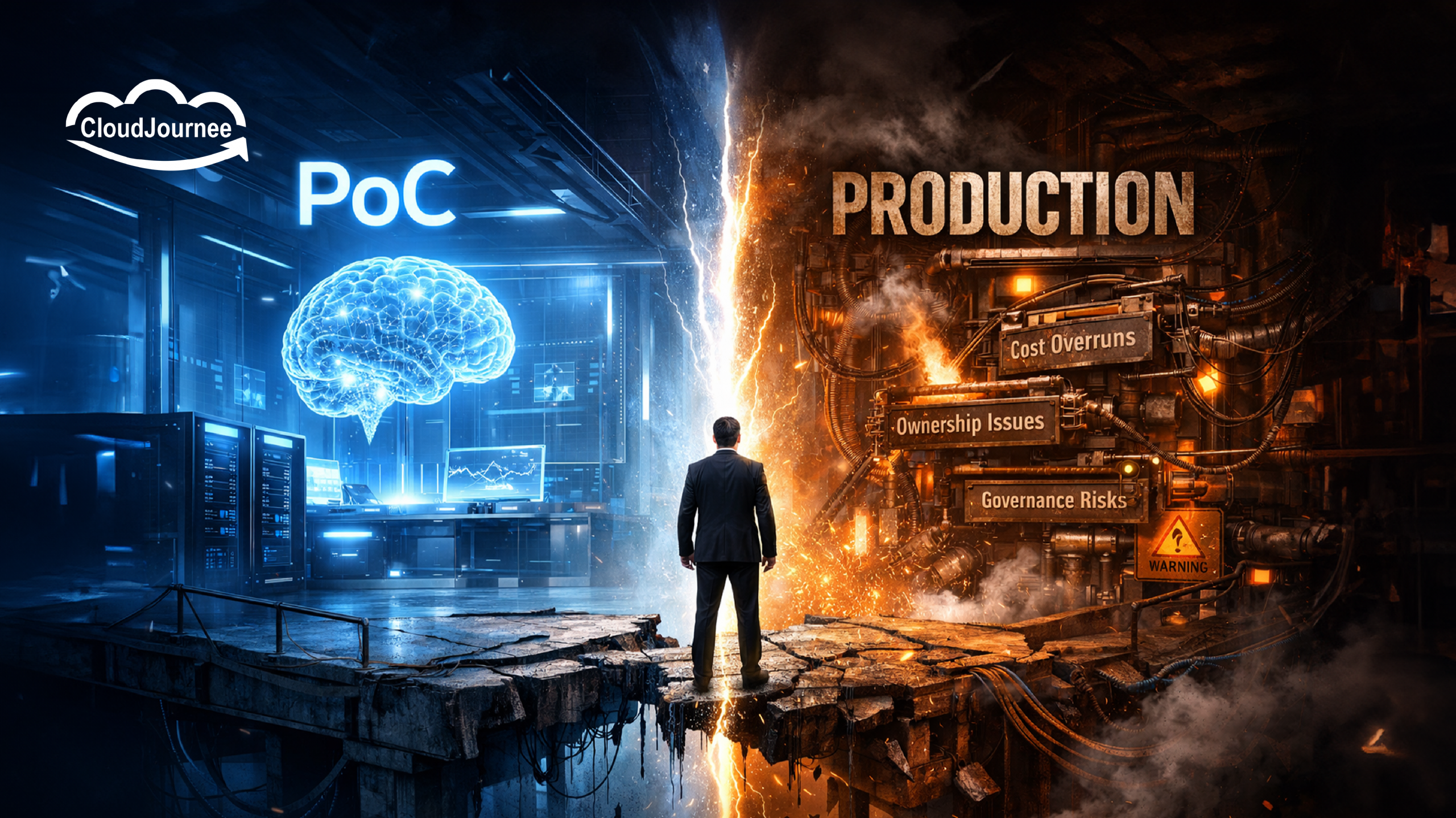
What if your most impressive AI demo is the very reason your project never goes live?
It works perfectly in the room. The outputs are sharp, the response time is instant, and the stakeholders leave energised. But a few weeks into the next phase, things shift. Requirements expand. Results become inconsistent. Real-world data starts breaking what once looked flawless in a controlled setting. This is not an edge case. It is the dominant pattern in enterprise AI adoption today, and it has almost nothing to do with the model itself.
According to Gartner, fewer than 54% of AI models make it from pilot to production, and an even smaller share achieves meaningful scale. McKinsey’s 2024 AI report notes that while 65% of organisations are now using AI in at least one business function, the majority still lack the operational frameworks needed to sustain it. The gap between a compelling demo and a production system that actually delivers is where most AI investments quietly stall.
The problem is not ambition. It is architecture — specifically, how POCs are designed, scoped, and tested before anyone writes a line of production code.
What Is a POC in AI — and Why the Definition Matters
A Proof of Concept is an early-stage implementation designed to validate whether a AI use case is technically feasible. It operates on limited scope, controlled inputs, and simplified workflows. The goal is not to build a complete system. It is to answer a single question: can this model deliver useful outputs for a specific problem, under specific conditions?
That qualifier — under specific conditions — is where almost every POC sets itself up to fail. Because the conditions of a POC are, by design, nothing like the conditions of production.
The Real Problem: POCs Are Built to Impress, Not to Survive
There is nothing wrong with how most POCs are built. They are optimised for the right goal — speed, believability, and early stakeholder alignment. You select the cleanest use case. You curate the data. You refine the prompt through twenty iterations until the output is exactly what you want to show. And it works.
But this creates a false signal. A successful POC proves that the model can generate a strong output under ideal conditions. Production requires the system to generate acceptable outputs under unpredictable conditions, at scale, against data it has never seen, integrated with systems it was never tested against. That gap — between what the POC proves and what production demands — is where most AI initiatives break.
The second and more damaging failure is what happens the moment the demo lands well. Stakeholders stop seeing the POC as a validation experiment and start seeing it as a near-finished product. The question shifts from “should we build this?” to “why isn’t this deployed yet?” Suddenly the scope absorbs new requests — more workflows, more integrations, more use cases — before the original system has been stabilised. An undefined system does not scale. It just accumulates complexity until it collapses under its own weight.
Four Reasons AI POCs Don’t Survive the Transition to Production
Scope expands the moment it works
Success is the trigger. The moment stakeholders see value, the natural instinct is to extract more of it — more workflows, more departments, more integrations. Each request sounds reasonable in isolation. Collectively, they expand scope far beyond the original design before the core system has reached a stable state. This creates increasing complexity, slower iteration, and a system that is perpetually in progress but never ready to ship.
There is no definition of done
Most POCs begin with a vague goal: make it work, show value, improve the outputs. But what does success actually mean in measurable terms? Is 80% accuracy acceptable, or does the business require 95%? What is the maximum tolerable response latency? What is the cost ceiling per request? Without clear answers, progress cannot be measured and decisions become subjective. One stakeholder believes the system is ready; another believes it needs more work. There is no shared benchmark to resolve that difference, so the POC stays in a cycle of indefinite refinement.
Demo data is nothing like production data
This is the most consistently underestimated risk. In a POC, data is curated — structured, clean, and predictable. It creates ideal conditions for the model to perform well. Production data is the opposite: inputs are incomplete, users phrase queries unpredictably, and edge cases appear constantly. The result is a sudden performance drop after deployment that erodes stakeholder confidence exactly when it needs to be highest. The model has not changed. The conditions have.
There is no plan for scale
Most POCs are built to work once, not to work repeatedly at volume. When usage increases, latency rises, costs spike, and reliability drops. Token usage scales non-linearly. Infrastructure constraints that were invisible at low volume become blocking issues at production load. Without cost estimation models, performance benchmarks, and monitoring frameworks built into the POC phase, scaling becomes a reactive crisis rather than a planned transition.
How CloudJournee Approaches This Differently
Before discussing frameworks, it is worth being direct about what actually causes these failures. It is almost never the model. It is three structural absences: no control over scope once the demo succeeds, no measurable definition of when the POC is complete, and no exposure to production-like data during the build. Fix those three things early, and the path to production becomes predictable. Leave them unaddressed, and even the most technically sophisticated POC becomes expensive to rescue.
This is the operating principle behind how CloudJournee structures AI engagements. As an AWS Advanced Tier Partner and holder of the AWS AI Competency — one of a small number of partners globally to hold this designation — we have spent considerable time identifying where the POC-to-production gap actually forms, and building the practices to close it before it opens.
Controlled scope from the start
We work with clients to define one use case, one measurable outcome, and a hard boundary on feature expansion during the POC phase. This is not a constraint on ambition — it is a guarantee that the first system will be stable enough to build on. Uncontrolled expansion is what prevents POCs from ever reaching closure. A focused system that works predictably in production is worth ten impressive demos that stall in transition.
A clear, pre-agreed definition of done
Every POC we run begins with measurable exit criteria: minimum acceptable accuracy, maximum tolerable latency, target cost per inference request. These are agreed before development starts. This changes the nature of every decision made during the build. Instead of asking whether something “feels ready,” teams can ask whether defined thresholds have been met. It removes ambiguity, creates alignment across stakeholders, and ensures the POC ends at the right time rather than continuing indefinitely.
Production-like data from day one
We deliberately avoid clean demo datasets. From the first sprint, we introduce real or simulated noisy inputs, edge cases that reflect how actual users behave, and validation scenarios drawn from realistic usage patterns. This makes the system harder to build in the first two weeks and significantly easier to deploy in production. By the time the POC is complete, the model has already been stress-tested against the conditions it will actually face.
Architecture designed for what comes next
Even at POC stage, we design with production in mind: modular components, configurable prompt workflows, cost monitoring baked into the architecture, and integration points that align with the client’s existing AWS infrastructure. On AWS Bedrock and related services, this means the POC is not a throwaway prototype — it is the first version of the production system. The result is a transition measured in weeks, not quarters.
Key insight
The transition from POC to production is not about improving the model. It is about improving the system around the model — the data pipeline, the observability layer, the cost controls, and the scope discipline that governs how the system evolves
What Actually Changes When You Move from POC to Production
The POC-to-production transition is not a technical upgrade. It is a shift in priorities, and teams that treat it as the former consistently underestimate the effort involved. In a POC, a few impressive outputs are sufficient to prove the concept. In production, consistency becomes the primary requirement — the system must behave predictably across thousands of requests, handling inputs it was never shown, at a cost the business has agreed to absorb.
Controlled inputs give way to real-world variability. Users do not interact with systems the way developers expect. Queries are incomplete, context is ambiguous, and intent is rarely explicit. Systems must be resilient, not just accurate. Cost, which rarely features in POC thinking, becomes a central constraint at scale — token usage multiplies with demand, and small prompt inefficiencies compound quickly into material budget overruns.
Standalone systems must become integrated ones. POCs operate in isolation; production systems must connect with existing applications, data pipelines, and business workflows. Integration complexity is almost always underestimated. And experimentation, where failure is acceptable and expected, gives way to accountability — where poor outputs affect user experience, delays impact operations, and cost overruns require explanation.
Deployment Challenges You Cannot Afford to Ignore
Even with a well-structured POC, deployment introduces a distinct set of challenges. Unpredictable user behaviour is the most common source of post-launch degradation — users query systems in ways no developer anticipated, and graceful handling of ambiguity must be engineered, not assumed. Output reliability requires active controls: without guardrails, models produce variability in tone, structure, and factual accuracy that erodes trust at exactly the moment adoption should be growing.
Cost volatility deserves particular attention. Usage spikes, high token consumption from inefficient prompts, and unmonitored API calls can escalate costs faster than most teams expect. Operational visibility — knowing what is working, what is failing, and where to improve — is the difference between a system that compounds in value and one that slowly degrades. Without observability, optimisation is guesswork. And as adoption grows, systems face scaling pressure that exposes every architectural shortcut taken during the POC phase.
Technical Reference: POC to Production Across Key Dimensions
The table below captures the most common failure patterns and the corresponding best practices across the ten dimensions that determine whether a AI system reaches production successfully.
| Area | What to Watch | Common Mistake | Best Practice |
|---|---|---|---|
| Prompt Management | Versioning, consistency, reuse | Hardcoding prompts in code | Centralised prompt repository with version control |
| Data Quality | Input variability, noise, edge cases | Using clean demo data only | Test with production-like, messy data from day one |
| Model Selection | Accuracy, latency, cost trade-offs | Choosing model on hype alone | Benchmark models against your specific use case |
| Evaluation | Output quality, hallucination rate | No structured evaluation metrics | Define measurable KPIs: accuracy, latency, cost |
| Scalability | Traffic spikes, concurrency | Designing only for low-volume usage | Plan for load and performance upfront |
| Cost Control | Token usage, API calls per request | Ignoring cost during the POC stage | Track cost per request and optimise prompts |
| Architecture | Modularity and flexibility | Building tightly coupled systems | Use modular, configurable workflows |
| Observability | Logs, monitoring, debugging | No visibility into failures | Log prompts, outputs, latency, and cost |
| Integration | Compatibility with existing systems | Treating POC as standalone experiment | Design for API integration from day one |
| Security & Compliance | Data privacy, access control | Ignoring governance in early stages | Implement guardrails and access policies early |
Fix the Start, Not the End
Most teams approach AI with the same instinct: build the POC quickly, then solve production challenges later. By the time they reach later, the system is already misaligned — the architecture was not designed for scale, the data was not representative, and the success criteria were never defined. Fixing those gaps after the fact is expensive, time-consuming, and demoralising for teams who built something impressive only to watch it stall at the last mile.
The better approach is to shift discipline earlier. Define constraints before writing code. Align stakeholders on measurable outcomes before development begins. Test under real conditions from the first sprint. When the foundation is strong, the transition to production is a natural continuation of the build, not a separate and unpredictable effort. When it is not, even technically sophisticated systems fail to deliver.
AI success is not determined by how fast you build a demo. It is determined by how well you prepare for what the demo becomes.
CloudJournee holds the AWS AI Competency, awarded to a select number of partners globally who have demonstrated verified production deployments and deep service expertise on AWS. If you are evaluating whether your current POC has a credible path to production — or designing one that does — we are happy to walk you through the framework we use.
Reach out at cloudjournee