
How CloudJournee turned a leading education technology organization’s static content library into an AI knowledge platform that answers only from approved curriculum — built on AWS with Amazon Bedrock and RAG.
A leading education technology organization had built something valuable: a library of more than 100,000 curriculum guides, lesson plans, assessments, worksheets, and reference materials, supported by over 500,000 educational images. The problem was finding anything in it. Students and educators spent 10 to 15 minutes hunting for the right resource — so most of the library went unused.
Today, a student or educator asks a question in plain language and has an accurate, curriculum-aligned answer in under 30 seconds — with the relevant diagrams alongside it.

The challenge
As digital learning programs grew, so did the content — across curriculum guides, lesson plans, assessments, worksheets, reference materials, and supporting visuals. But a rich repository is only as good as a user’s ability to find what’s in it, and discovery had not kept pace:
- Finding content took 10–15 minutes. Students and educators searched manually across more than 100,000 documents to locate a single relevant resource.
- Educators lost 3–5 hours every week. Time went into searching, validating, and organising content for lesson planning instead of teaching.
- Keyword search couldn’t understand intent. Exact-match queries returned incomplete or irrelevant results, and got worse as the library grew.
- Learning stayed static. Material sat in PDFs and fixed resources, with no contextual exploration and no easy path to the supporting diagrams that reinforce a concept.
- Under 40% of the library was actually used. Significant investment in content creation was going unrealised because learners couldn’t find it.
Why the obvious options didn’t work
- Document repositories and LMS platforms store and organise content well, but offer no intelligent discovery — users still navigate large volumes by hand.
- Keyword search engines match strings, not meaning. They can’t read intent, learning context, or the relationship between topics.
- Conventional knowledge bases can’t associate content, metadata, and supporting visuals into a coherent learning response.
- Generic AI chatbots have no access to institution-specific curriculum — so they answer from the open internet, or invent an answer entirely.
That last point mattered most, and it shaped the entire solution.
Answers you can trust in a classroom
A general-purpose AI assistant will answer a question about your curriculum whether or not it actually knows the answer. That’s a problem when the person asking is a student.
This platform only answers from the organization’s own approved educational content. Every response is grounded in retrieved source material, with Amazon Bedrock Guardrails filtering for quality and relevance. If the material isn’t in the library, the platform doesn’t invent it. That’s what makes 95%+ retrieval accuracy meaningful rather than merely impressive — the answers are anchored to what educators actually wrote.
The solution
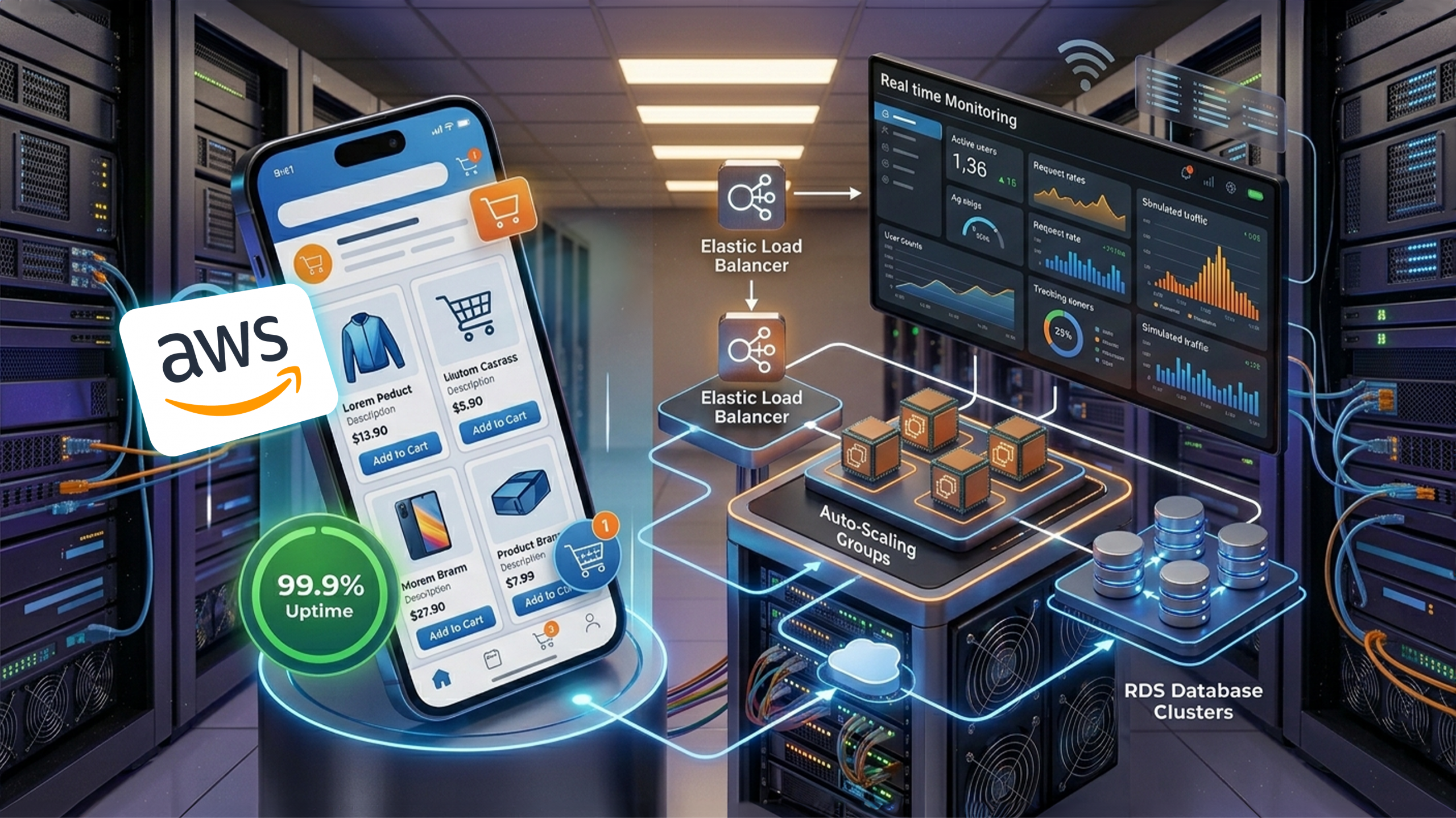
CloudJournee built an AI-powered educational knowledge platform on AWS that lets students and educators discover content through natural-language interaction. Educational documents are ingested automatically from Amazon S3 via AWS Lambda, split with semantic chunking, converted to vectors by Amazon Titan Embeddings, and indexed in Amazon Aurora PostgreSQL with pgvector. An Amazon Bedrock Knowledge Base performs semantic retrieval across the corpus, and Amazon Nova Pro generates a contextual, curriculum-aligned response grounded strictly in what was retrieved.
Supporting educational images — more than 500,000 of them, stored in Amazon S3 and associated with the source content — are surfaced alongside each answer, so a learner gets the explanation and the diagram together. Amazon ECS Fargate hosts the chat interface, with Amazon API Gateway providing secure endpoints and Amazon Cognito handling authentication. Amazon CloudWatch and AWS CloudTrail deliver monitoring and audit, and Amazon Bedrock Guardrails enforce responsible-AI controls on every response.
How CloudJournee delivered it
- Engineered for retrieval quality, not just retrieval. We designed the content model — semantic chunking, parent–child hierarchy, and re-ranking — around how educational material is actually structured, which is what took accuracy past 95%.
- Automated the content pipeline. An event-driven ingestion framework processes documents, images, and metadata from Amazon S3 with no manual preparation, so the knowledge base stays current as the library grows.
- Built grounding and governance in from the start. Amazon Cognito, AWS IAM, Bedrock Guardrails, CloudTrail, and CloudWatch were part of the architecture, not a later addition — essential when the audience is students.
- Validated against real classroom use. Retrieval accuracy was measured across educational scenarios, with user acceptance testing run with students and educators before rollout.
- Handed it over ready to run. Architecture documentation, operational guidance, and deployment knowledge transfer support long-term adoption on managed AWS services. .
The results
| Metric | Before | After | Improvement |
|---|---|---|---|
| Content discovery time | 10–15 minutes | Under 30 seconds | ~95% faster |
| Content utilization | Under 40% | 75%+ | Nearly doubled |
| Retrieval accuracy | Keyword matching | 95%+ | Semantic & grounded |
| Educator time on content search | 3–5 hours per week | Minutes | Hours returned to teaching |
| Learning resource access | Manual navigation | Natural-language search | Self-service |
| Supporting visuals | Searched separately by hand | Surfaced with each answer | Automatic |
| Content experience | Static PDFs | Interactive, contextual | Conversational |
The business value
Content investment finally pays off. Utilization rose from under 40% to more than 75% — the same library, delivering nearly twice the value, without creating a single new document.
Hours returned to teaching. Educators recovered 3–5 hours a week previously lost to searching and organising, redirected to lesson quality and classroom time.
A learning experience, not a file cabinet. Static PDFs became contextual, conversational exploration — with supporting visuals attached to every answer, improving engagement and comprehension.
Trustworthy by design. Grounded responses, Guardrails, encryption, and full auditability mean an AI platform that schools can put in front of students with confidence.
A foundation for what’s next. The managed, AWS-native architecture scales with the content library and extends naturally to personalised learning, assessment support, and future AI-driven experiences — without re-architecting.