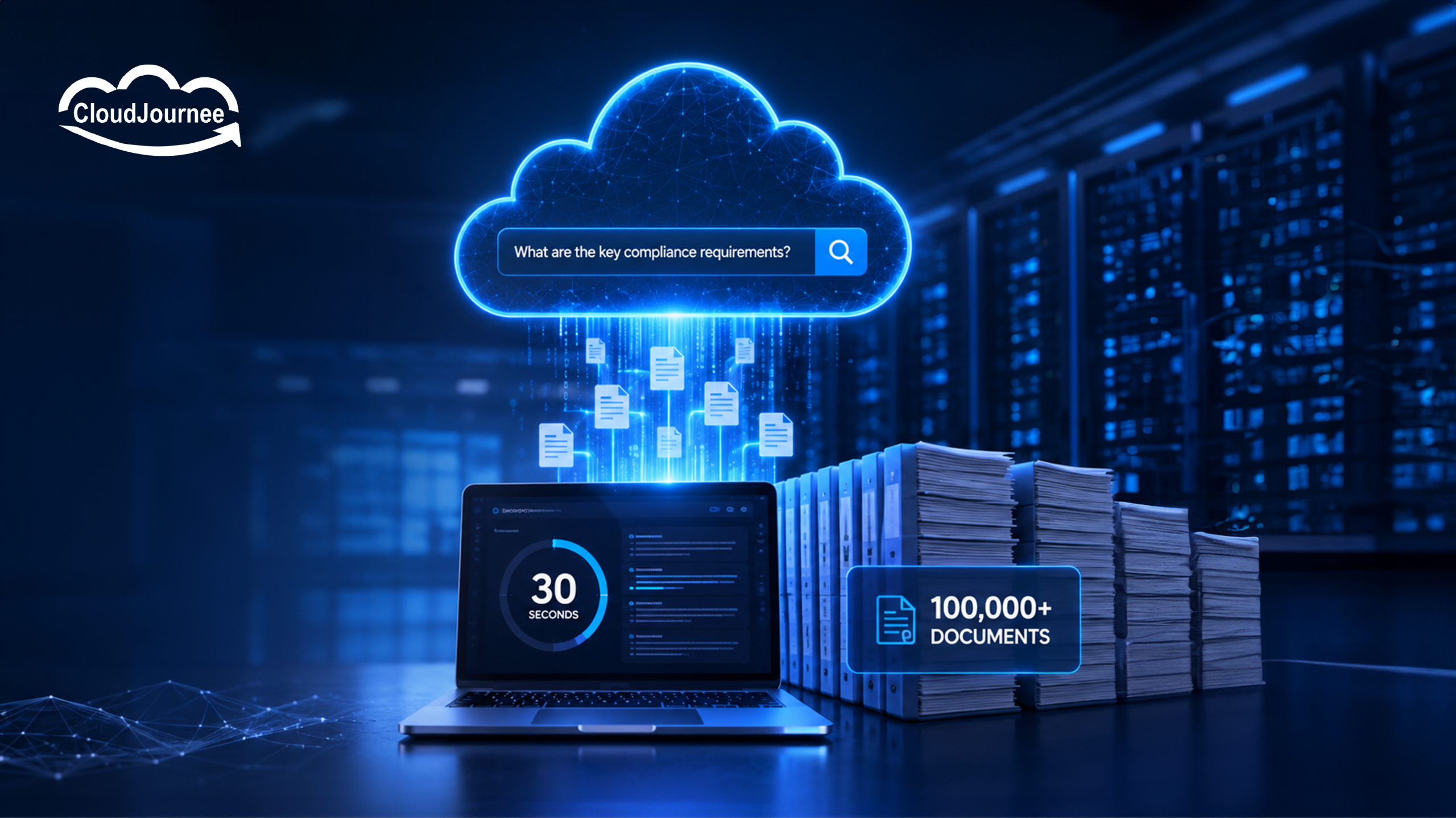

How CloudJournee built an agentic AI platform for a technology consulting firm — one that researches a topic, writes it, and checks its own work. On AWS.
A technology consulting and product engineering company was spending hours — sometimes more than a day — researching and authoring a single e-book. Subject-matter experts hunted across the open web for credible sources, validated them by hand, pieced the material together, and only then started writing. Quality shifted from author to author, and every new topic began the whole cycle again.
Today, their platform researches a topic, drafts it, critiques its own output, rewrites what falls short, and delivers a publication-ready e-book in under 15 minutes — with a human reviewer looped in only when the system isn’t confident enough to publish.

The challenge
Producing a single high-quality e-book started as an open-ended research problem. A specialist had to find relevant online sources, judge whether each was credible and current, extract the useful material, reconcile overlapping information, and then draft structured chapters. As demand grew, the model strained in predictable ways:
- Research consumed the majority of authoring time. Experts spent their days on repetitive discovery and validation instead of higher-value work.
- Publication cycles ran to hours or days. Manual research and aggregation delayed every title.
- Output couldn’t scale without headcount. More content meant proportionally more expert hours — there was no other lever.
- Quality varied by author. Depth, structure, and tone shifted from person to person, making a uniform standard hard to guarantee.
Why the obvious options didn’t work
- Traditional content management tools store and organise documents, but have no capacity for autonomous research or synthesis.
- A single large-language-model prompt can draft fluent prose, but can’t reliably ground it in real sources, judge its own accuracy, or recognise when the material simply isn’t good enough.
- A custom AI build would have demanded specialised ML engineering, long timelines, and ongoing maintenance cost the business didn’t want to carry.
- Standalone AI point tools solve one step each, leaving the end-to-end workflow — discovery through publication — stitched together by hand.
The company needed something that could reason about the work as it went, not just generate text on command.
The system that checks its own work
Most AI content tools generate once and hope. This platform doesn’t.
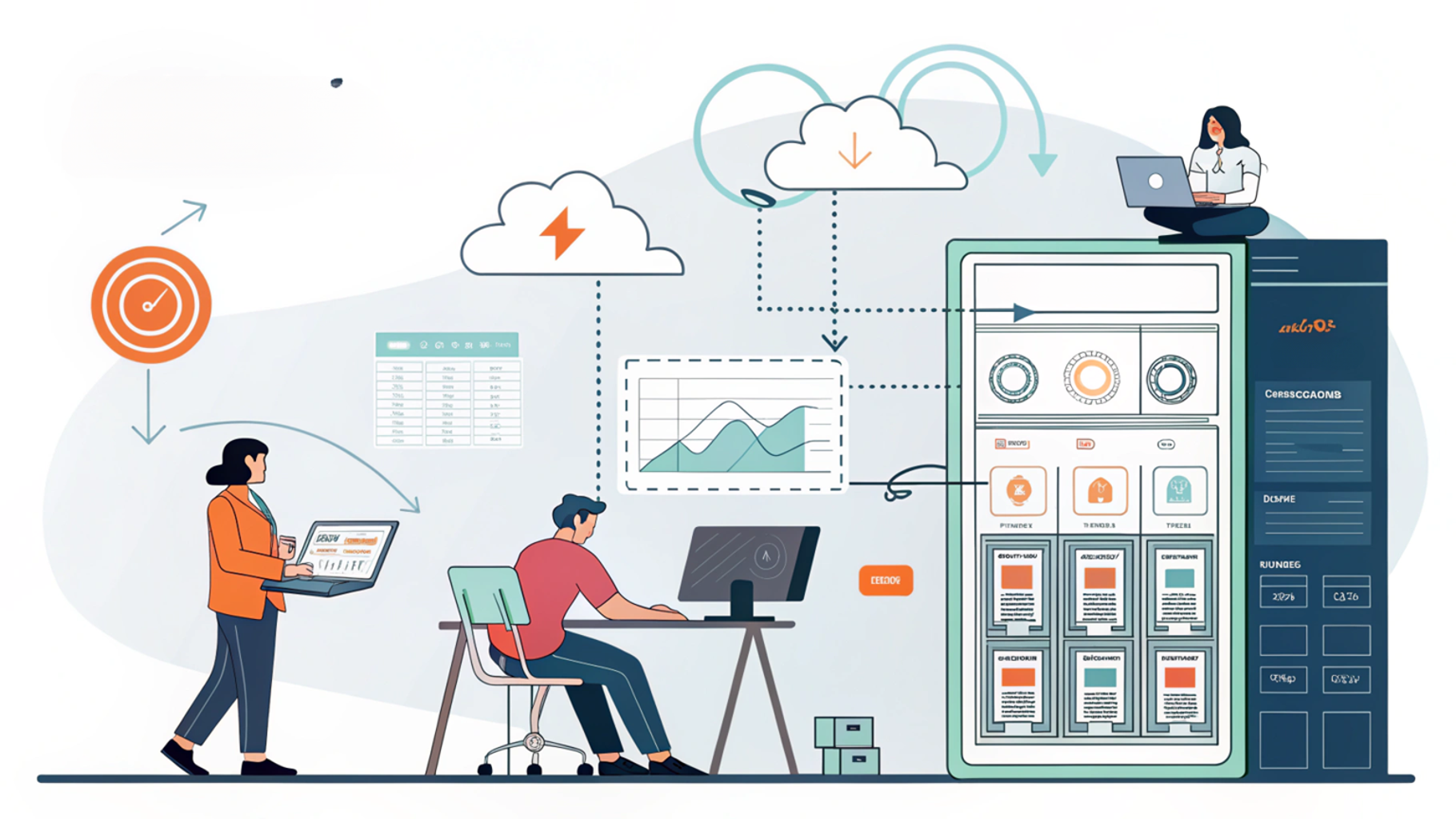
After researching a topic, it asks itself whether it has gathered enough material to cover the section — and if the answer is no, it reformulates its search and goes back for more. After drafting, it critiques its own output for grounding, coverage, and quality. If the writing falls short, it rewrites the section using that critique as guidance. If the sources were the problem, it returns to research. It keeps going until the work meets the bar.
And when it can’t get there, it doesn’t quietly publish something weak or drop in placeholder text — it flags the section for a human reviewer. That single design decision is what makes unattended operation safe to trust at scale.
whether it has researched enough, whether a draft is good enough, and what to do
when it isn’t — search again, rewrite, or escalate. Two different topics can take
two different paths through the same workflow.
The solution
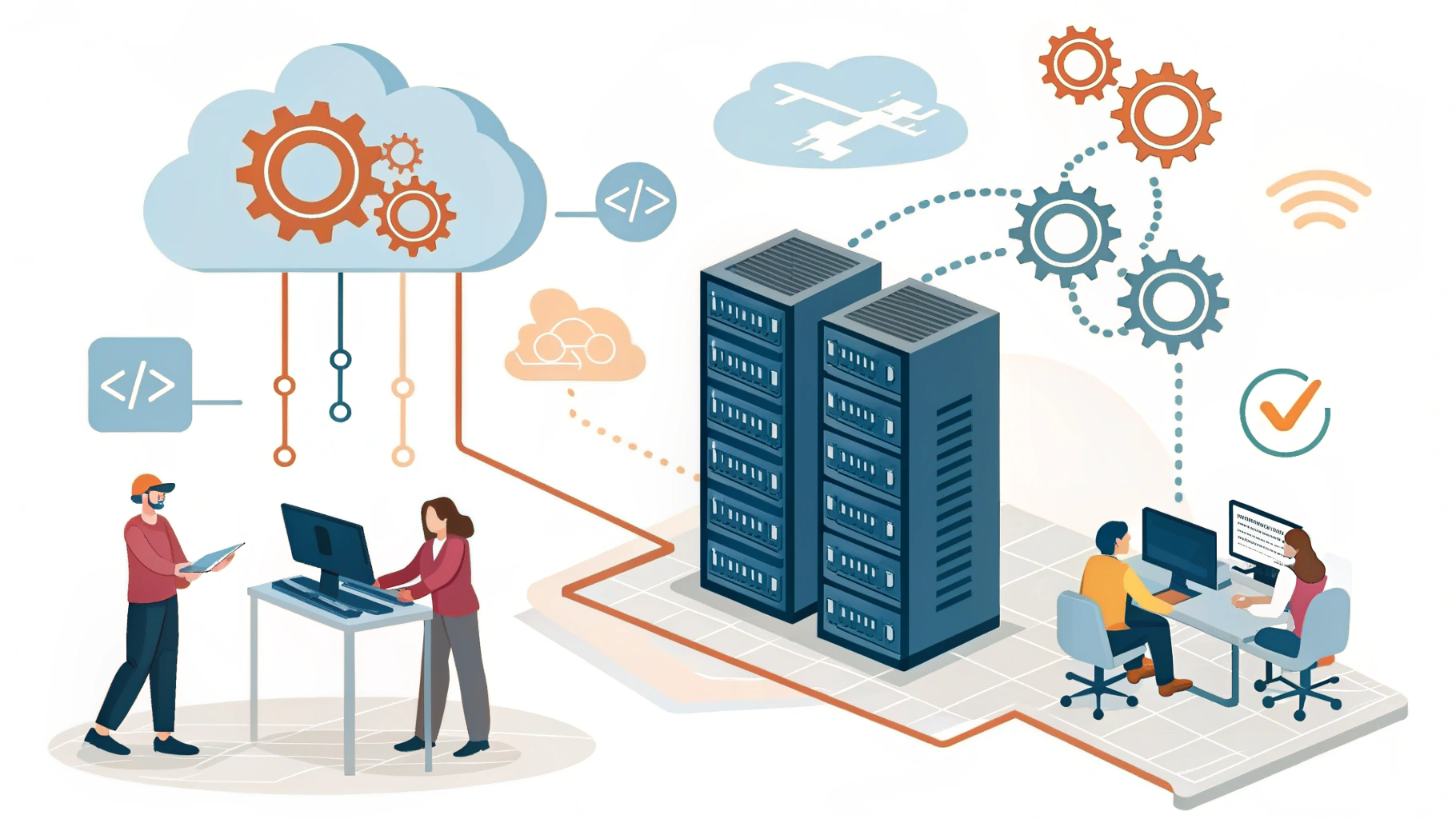
CloudJournee designed and delivered an agentic AI content-discovery and e-book generation platform on AWS. A user uploads a spreadsheet of domains and topics through a web application, selects a topic, and the platform takes over — researching, reasoning, drafting, self-checking, and assembling a finished e-book delivered as PDF and JSON.
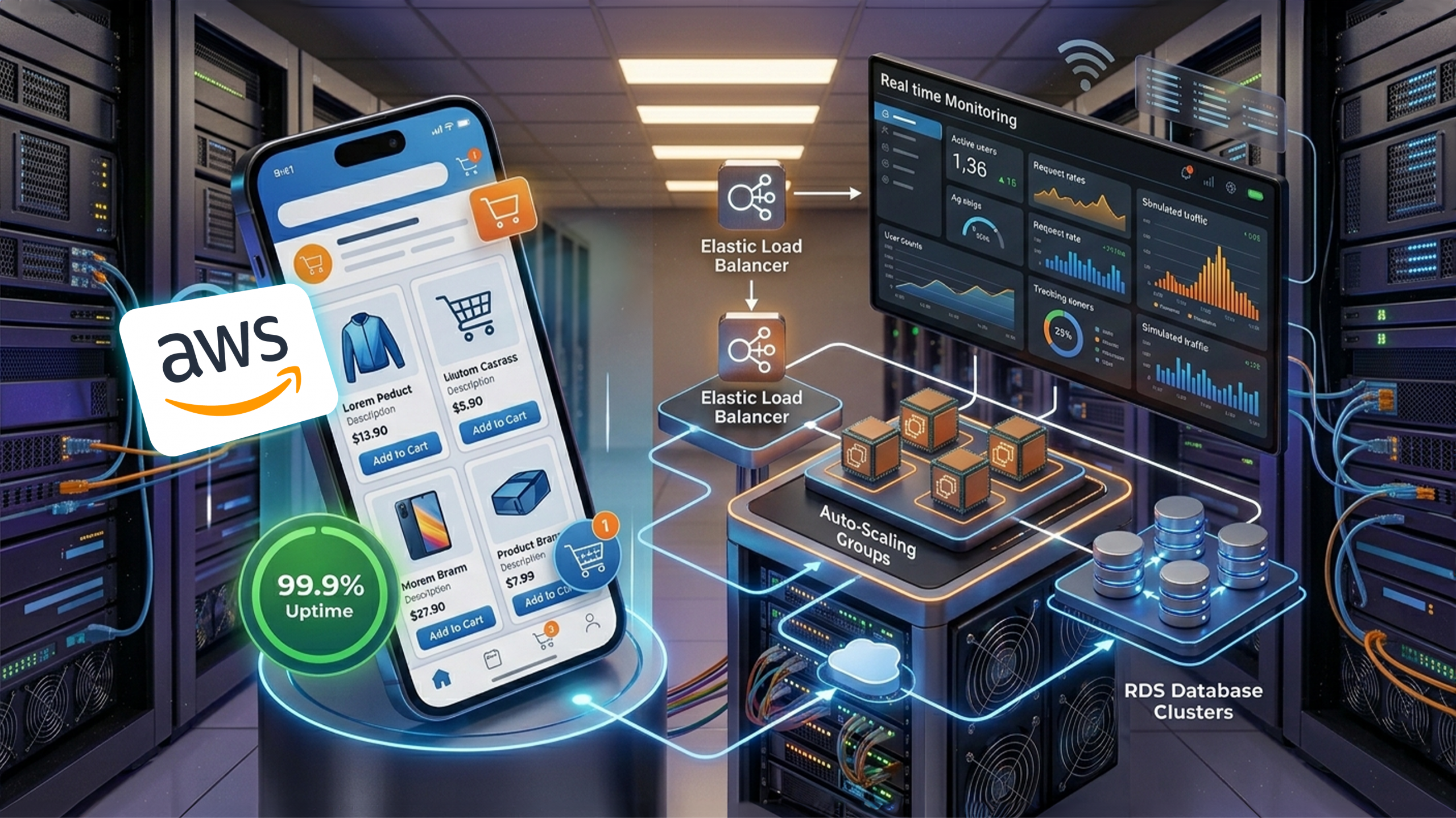
A LangGraph orchestrator governs the workflow and coordinates specialised agents, running on Amazon Bedrock AgentCore Runtime — a managed, serverless runtime purpose-built for agents. Amazon Nova Pro, accessed through Amazon Bedrock, performs the content analysis, synthesis, drafting, and the self-evaluation critique. LangChain manages model interaction, prompt execution, and tool invocation, while the Tavily Search API provides intelligent URL discovery, ranking, and content retrieval.
Amazon ECS Fargate hosts the user-facing web application, with Amazon API Gateway providing secure endpoints for uploads, topic selection, and generation requests, and Amazon Cognito handling authentication. Amazon S3 stores uploaded inputs, retrieved source content, and final outputs. Amazon CloudWatch and AWS CloudTrail deliver monitoring, tracing, and a full audit trail, with AWS IAM and encryption enforcing least-privilege access and data protection throughout. The platform runs across two Availability Zones in the AWS Asia Pacific (Mumbai) region.
How CloudJournee delivered it
- Designed for autonomy, not automation. We evaluated Amazon Bedrock foundation models against real workload needs and selected Amazon Nova Pro for its balance of quality, latency, and cost — then chose LangGraph specifically because it models agent behaviour as a state graph, giving the conditional branching and loops the self-correcting workflow depends on.
- Built it as production software. Agent logic, prompts, and tool integrations were written in code and version-controlled, so the orchestration, prompting strategy, and evaluation criteria could be reviewed, tested, and refined like any other production system.
- Validated quality across domains. End-to-end testing covered the research and generation workflow, output quality and consistency across a range of topics, and reliable operation under concurrent load.
- Made it observable in production. AgentCore’s built-in tracing gives visibility into the agent’s reasoning steps, tool calls, and evaluation decisions — invaluable for tuning prompts and quality thresholds over time.
The results
| Metric | Before | After | Improvement |
|---|---|---|---|
| E-book creation time | Hours to over a day | Under 15 minutes | ~95% faster |
| Content discovery | Manual multi-site search | Under 10 minutes, automated | AI-powered |
| Research effort | Majority of authoring time | Automated discovery & synthesis | ~70% reduction |
| Content-creation productivity | Manual baseline | Self-service generation | +65% |
| Workflow automation | Manual end to end | Orchestrated agentic workflow | 85% automated |
| Generation success rate | Author-dependent | Quality-checked output | 95% |
| Content consistency | Varied by author | Standardised, grounded structure | Uniform |
| Concurrent capacity | Limited by headcount | Cloud-native elastic scale | 200+ requests |
| Platform availability | — | Managed, Multi-AZ on AWS | 99.9% |
The business value
Operational excellence. Work that consumed hours of specialist research now completes in minutes, at a consistent quality standard. Teams review and direct rather than hunt and transcribe, and people are involved only where their judgement adds the most value.
Trustworthy automation. Because the system escalates rather than guesses, staff can rely on unattended output — and focus their attention on the minority of sections that genuinely need a human eye.
Economic scale. Rising content demand is absorbed by the platform rather than by additional headcount, and pay-per-use managed services keep operating costs predictable without custom AI infrastructure to maintain.
Security and governance by design. Amazon Cognito, AWS IAM, encryption, and private-subnet isolation protect the platform, while CloudWatch and CloudTrail provide an end-to-end record of what the system did and why.
A foundation for what’s next. The same architecture extends naturally to other research-and-synthesis problems — market and competitive research, technical documentation, knowledge-base creation — wherever output quality depends on the rigour of the self-checking behind it.